
We use cookies to provide you with the best possible online experience. Read our cookie policy.

GM Daily: Market risk appetite fades
Global: One-year notice
SA: Further signs of economic distress
Rand: Trading above 17 as risk appetite fades
Local rates: Weak nominal auction
What to watch today
- US MBA Mortgage Applications
- US Consumer Credit
Covid-19 update
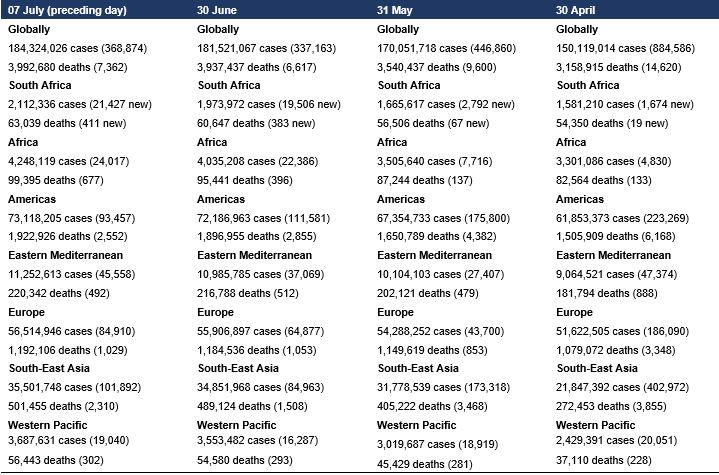
Source: WHO, NICD
Economics and markets
- The US has tendered its one-year notice to the UN for its exit from the WHO.
- The gold price rose quite steeply yesterday, which could indicate that market sentiment is showing some bias towards safer havens.
- The rand starts the day off almost 20 cents weaker than yesterday’s open and should trade above 17.00 to the US dollar if risk sentiment remains wary.
- SA’s interest burden on the sovereign’s ten-year bond (the R2030) has now spiked above that of Nigeria’s equivalent.
- USD/ZAR opens at 17.17; EUR/ZAR at 19.36; GBP/ZAR at 21.53 and CNY/ZAR at 2.45.
President Donald Trump has followed up on his threat to leave the World Health Organisation. The US has tendered its one-year notice to the UN, with the world’s largest economy due to officially exit on 6 July 2021. This is troubling, as the WHO gets its largest funding injection from the US and oversees more than just the global response to covid-19. The irony of course is that the spread of covid-19 in the US is not showing any signs of slowing down and is posing new threats to the country’s economic recovery.
This could very much explain the poor performance of US equity markets yesterday, with the Dow and S&P 500 falling over 1% on the day and the Nasdaq closing 0.86% lower. Asian bourses have shown muted movements this morning, with only the ASX falling by over 1%, and the Nikkei down 0.6%, but the Hang-Seng and Shanghai Composite index in the green. The gold price rose quite steeply yesterday, which could indicate that market sentiment is showing some bias to safer havens. Thus SA could see the local bourse trading mutedly, and possibly following the trend lower, with the rand starting the day off almost 20 cents weaker than yesterday’s open and liable to trade above 17.00 to the US dollar if risk sentiment remains wary.
In other not so good news for SA, it would seem that the interest burden on the sovereign’s ten-year bond (the R2030) has now spiked above that of Nigeria’s equivalent, suggesting that despite Nigeria’s lower sovereign rating, investors are requiring greater return to help SA cover the gap between its expenditure and revenue. It will be a quiet day on the data front globally, but also in SA, providing a brief respite after yesterday’s poor 2Q20 consumer confidence print of -33, the worst number since 1985. This should not come as too much of a surprise given the already poor outcome of the business confidence survey, but does confirm that households came under substantial pressure during SA’s hard lockdown and the gradual easing thereof. There was further news which suggests the third quarter is in for a tough recovery, with the announcement of 1,800 job cuts from Walmart-owned Game. Adding to SA’s economic woes is that Naspers will be ending a number of publications and reducing the frequency or speeding up the digitalisation of others in response to the crisis. This only confirms that the current economic crisis will not only provide temporary declines in activity, but will probably also contribute to a permanent decline in private sector activity.
It is in this context, and in response to a call to reject the Special Adjustment Budget, that Deputy Governor Kuben Naidoo has warned that such a move would not fix SA’s economic problems, but rather speed up its path to default, saying, “… as sure as the sun will rise tomorrow, at some point we will have to repay the debt…”, a warning, and a reality, that we as taxpayers should all heed.
Siobhan Redford
Local rates
We saw a few more local and offshore names in this week’s nominal auction, however, the underlying threats of increased auction issuance, coupled with a 100% greenshoe offering, persist, which was highlighted by yesterday’s auction results. Despite the mildly positive risk sentiment going into auction, the affair was quite a non-event. The R186’s cleared auction at 7.90 (7.85 market) with a bid-to-cover ratio of 1.75, while the R2030s cleared auction at 9.70 (market 9.61) with a bid-to-cover ratio of 1.68. The ultra-long provided mild enthusiasm with a high bid-to-cover ratio, but it cleared at market, R2048s cleared auction at 11.75 with a bid-to-cover ratio of 2.46. The flows on the desks suggests that there is better preference for the front end of the curve despite yesterday’s auction results, while there was better selling interest yesterday, the R2023 up to the R2032 had two-way flows from local fast and real money accounts, though volumes remain relatively low. With the ILB curve a bit elevated, demand for the back-end linker stock resumed, with interest from local real money accounts for the I2038, I2046s and I2050s. On the IRD front, interest for longer-dated packs is gaining momentum, with the 20-yr/R2040 and 30-yr/R2048 middling at -3.71 and -3.63 respectively. There was some activity on the front end of the FRA curve yesterday, in particular the 1x4 and 3x6, where we had some local real money receiving sub 10-yr on the IRS curve.


