
GM Daily: We’re all going on a provincial holiday
Global: US economy suffers worst quarter since WWII
SA: Could a relaxation of restrictions on tourism industry foreshadow further easing?
Rand: Losing its hold on USD/ZAR16.50 as US data triggers flight to safety
Local rates: Pulling in opposite directions
What to watch today
- UK GfK Consumer Confidence
- UK Lloyds Business Barometer
- CH Manufacturing PMI
- EC GDP SA (y/y)
- SA Trade Balance
- US Personal Income
- US Personal Spending
- US MNI Chicago PMI
- US University of Michigan Sentiment
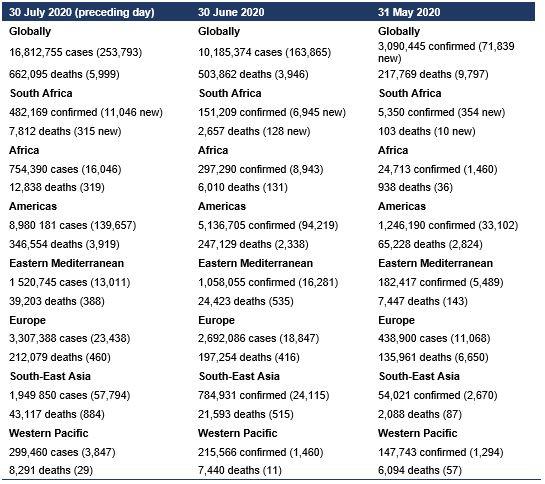
Covid-19 update
Source: WHO, NICD
Economics and markets
- The government has thrown a lifeline to the ailing tourism sector, which is at risk of shedding 400,000 jobs and more than R80bn in foreign receipts.
- Job preservation is of the utmost importance as the UIF covid-19 Temporary Employer/Employee Relief Scheme (TERS) benefit peters out.
- Regardless of the level of development, the most advanced countries are battling covid-related shocks.
- As the Fed stressed in its FOMC statement this week, “The path of the economy will depend significantly on the course of the virus”.
- The key differentiating factor between the US and its European cohorts, however, is coordinated policy support
- Fearful of the fundamental economic weakness across the globe, investors have fled to US treasuries and gold.
- USD/ZAR opens at 16.76; EUR/ZAR at 19.86; GBP/ZAR at 21.95 and CNY/ZAR at 2.39.
Cliff Richard was a favourite in my household growing up. Fond of his rock and roll hits, my parents would play his records on a Sunday afternoon. Summer Holiday was a particular favourite during the December break. The lyrics described the joy of a short vacation. Fun, laughter and no more worries for a week or two. Now isn’t that a novel idea? I might sound a little jaded, but like many of us, a little reprieve would be welcome. Unlikely the motivation though for the government’s relief to the tourism and hospitality industry. By permitting individuals to book intra-provincial hotel accommodation for leisure and enjoy eateries after curfew, the government has thrown a lifeline to the ailing tourism sector, which is at risk of shedding 400,000 jobs and more than R80bn in foreign receipts.
Borne out of a desperate need for economic survival rather than a flattening in daily case rates, the relaxation of restrictions is perhaps foreshadowing further easing in other distressed industries. High-frequency economic data continues to point to depressed activity and muted confidence as businesses struggle to contend with paper-thin margins and weakened profitability. Job preservation is of the utmost importance as the UIF covid-19 Temporary Employer/Employee Relief Scheme (TERS) benefit peters out. Various relief measures have run their course, demanding structural reform to enable a return of activity.
SA’s economic story is not as unique as we’d like to think. Regardless of the level of development, the most advanced countries are battling covid-related shocks. The US shrank by 32.9% y/y in 2Q20, its sharpest contraction since the second world war, as more signs emerged of the coronavirus pandemic’s heavy toll on the economy. Recall that at the height of the GFC, the US’s worst annualised quarterly performance was an 8.4% decline, underscoring the severity of the current crisis. As the Fed stressed in its FOMC statement this week, “The path of the economy will depend significantly on the course of the virus”.
A message that rings true across the globe. Europe is suffering the same fate, with Germany revealing a 10.1% contraction in activity between April and June. The key differentiating factor between the US and its European cohorts, however, is coordinated policy support – something sorely missing from the US landscape as politicking continues ahead of the presidential election, which the President might look to delay.
The market’s response to the wall of weak data is predictable. Fearful of the fundamental economic weakness across the globe, investors have fled to US treasuries and gold. As you’d expect, EM currencies are struggling, with the rand surrendering 20c to the US dollar – its worst performance in more than six weeks. Strong Chinese PMI offers a meaningful backstop, allowing possible consolidation at USD/ZAR16.77 levels. In theory, rand gains should be hard fought in a structurally weaker economic environment because of SA’s dire fiscal position. But there are technical issues, such as the incoming multilateral inflows, that could create tactical opportunities, which should prove marginally rand positive. In the interim, however, risk sentiment will continue to set the tone for rand moves.
Enjoy the weekend reprieve.
Nema Ramkhelawan-Bhana
Local rates
This month-end has been interesting, to say the least. With the currency weakening aggressively yesterday, we saw bonds under pressure for the third day in a row. The yield curve continued steepening, albeit not as much as it had done on Tuesday and Wednesday. Flows remain light, however, with turnover of only R19bn on the day, of which foreigners were net sellers. Locals, however, stepped up to the plate and were reported as net buyers yesterday.
Today, we see both coupons of approximately R28bn that will be disbursed, but on the other hand, we have another GBI EM rebalancing, which sees SA’s weighting in this index drop further. The question is, how much of this flow has already happened, and will these two factors net each other off? The rand has managed to recover some of its losses overnight, so this might help bonds this morning, but flows should dictate price action today.
The National Treasury comes to market today, issuing R2bn spread across I2025s, I2033s and I2046s. Market participants were better sellers of ILBs yesterday, and we should see that filter into today’s auction. We expect the auction to be fully allocated, but yields to clear higher than mark-to-market levels.
Michelle Wohlberg
loading form...