
GM Daily: Vaccine hope springs eternal
Global: Equities on the front foot at the start of the week
SA: SARB to cut or not to cut?
Rand: Rangebound though with a bias towards weakness
Local rates: Rand remains vulnerable
What to watch this week
Monday
- JN Capacity Utilization
- EC Industrial Production
Tuesday
- CH Retail Sales (y/y)
- UK Jobless Claims Change
- UK Employment Change 3M/3M
- US Empire Manufacturing
- US Industrial Production (m/m)
- US Capacity Utilization
- US Manufacturing (SIC) Production
Wednesday
- JN Trade Balance
- UK CPI (y/y)
- UK Retail Price Index
- UK PPI Input NSA (y/y)
- UK House Price Index (y/y)
- EC Trade Balance SA
- US MBA Mortgage Applications
- SA Retail Sales
- US Retail Sales Advance (m/m)
- US NAHB Housing Market Index
- US FOMC Rate Decision
Thursday
- EC Construction Output (y/y)
- EC CPI (y/y)
- UK Bank of England Bank Rate
- US Philadelphia Fed Business Outlook
- US Initial Jobless Claims
- US Continuing Claims
- SA SARB Announce Interest Rate
Friday
- JN Natl CPI (y/y)
- GE PPI (y/y)
- EC ECB Current Account SA
- US Current Account Balance
- US Leading Index
- US of Mich. Sentiment
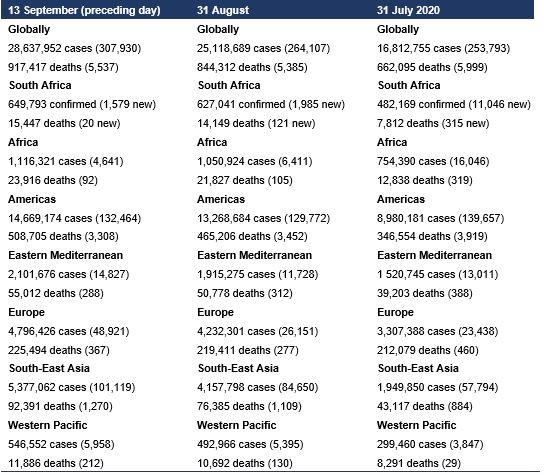
Covid-19 update
Source: WHO, NICD
Economics and markets
- Pfizer has provided a strong catalyst for gains as its CEO hints at the possible deployment of a covid-19 vaccine before the end of the year.
- Amid the quiet, Nvidia’s purchase of Softbank’s chip division, Arm, for US$40bn has ignited Asian markets.
- With a quiet week ahead of us, the Federal Reserve’s meeting could rattle global markets.
- The BOE faces a conundrum on Thursday.
- US equity benchmarks appear deflated. Arguably, the weakness has been concentrated in a few stocks.
- While the domestic data calendar is light this week, focus will be on the SARB’s interest rate decision.
- This will be the turning point for the rand, which remains rangebound.
- USD/ZAR opens at 16.75; EUR/ZAR at 19.82; GBP/ZAR at 21.43 and CNY/ZAR at 2.42.
Markets have kicked off the week on a positive note, reversing the declining trend of the past two weeks. Pfizer has provided a strong catalyst for gains as its CEO hints at the possible deployment of a covid-19 vaccine before the end of the year – a headline that will probably be exaggerated in the absence of any other market-moving data or news this week. Amid the quiet, Nvidia’s purchase of Softbank’s chip division, Arm, for US$40bn has ignited Asian markets, with Japan’s main board revelling in the news flow up over 0.5%. The Hang Seng and ASX are up over 0.6%, with the Shanghai bourse lagging with growth of close to 0.2% for the day.
With a quiet week ahead of us, the Federal Reserve’s meeting could rattle global markets, which are currently expecting a fairly dovish signal as the Fed begins its new monetary policy strategy. The BOE faces a conundrum on Thursday as it evaluates its rates strategy against renewed restrictions, the withdrawal of fiscal support and increasing odds of a no-deal Brexit. While the Fed and ECB have ostensibly paused, the BOE might need to announce explicit QE intervention. Brent crude opens the week below US$40/bbl and will probably remain quite low as waves of covid-19 affect different regions, suggesting that demand will remain relatively suppressed. Demand and supply estimates published in OPEC’s demand and production monthly, due for release today, will be closely watched ahead of the group’s meeting this week.
US equity benchmarks appear deflated. Arguably, the weakness has been concentrated in a few stocks with only 25% of S&P counters selling off, compared to the near 50% in March. On a year-to-date basis though, the US has outperformed. Indeed, the average monthly turnover on notional call options being traded in the US soared eight times in August to US$40bn, relative to US$5bn transacted between 2000 and July this year. The SA market has been a laggard over the last month despite last week’s strong showing. There is a slight tailwind forming from value investing, though we can’t escape the broader macroeconomic woes.
While the domestic data calendar is light this week, focus will be on the SARB’s interest rate decision. We expect the monetary policy committee (MPC) to cut the repo rate by 25bp to 3.25% at the September meeting. This will be driven by a downward revision of the bank’s 2020 growth estimate from its July projection for a contraction of 7.3% after the worse-than-expected GDP print last week. This decision will be further supported by the favourable inflationary environment in SA.
This will be the turning point for the rand, which remains rangebound, though with a bias towards weakness. Support and resistance levels have, however, shifted lower, with the lower and upper technical bounds at 16.25 and 16.95 against the greenback. EMs suffering a resurgence in cases will come under increasing pressure, regardless of whether a vaccine is forthcoming or not, as the eventual disbursal of treatment will probably be uneven. This will manifest in weaker currencies, resulting in greater differentiation in EM currency pairs.
Savour that first cup of caffeine. It’s going to be a long, drawn-out week.
Siobhan Redford & Nema Ramkhelawan-Bhana
Local rates
Interest in Friday’s inflation-linked auction was not as exciting as in previous weeks, with the auction stock clearing at market. With the back end on offer, the National Treasury came to market to issue I2038s, I2046s and I2050s: the I2038s cleared auction at 4.63 (market 4.63) with a bid-to-cover ratio of 1.44, the I2046s cleared auction at 4.67 (market 4.67), while the ultra-long cleared auction at 4.67 (market 4.67). We had local two-way flow on the 46s and 50s at auction clearing levels and coupled with tiny I2025s sellers around the 2.75 level. Other than that, the linker market was relatively quiet on Friday.
The front end of the FRA curve remains better paid by local fast money with the 3x6 attracting the bulk of the interest, while we also saw payers of the 21x24s. The market had some much-needed receivers coming into the sub-12-yr tenor on the IRS, but participants were better payers of the curve in general.
The nominal curve remains steep with the desk seeing local real money buying R2020s and R2032s as the R2044/R186 spread is middling around the 430bp handle. The market remains skittish for now and overall liquidity is challenging. The rand remains vulnerable around the familiar 16.70 mark ahead of tomorrow’s nominal auction where the National Treasury will be issuing R2032s, R2037s and R2048s.
Good luck for the rest of the week.
Tebogo Mekgwe
loading form...