
GM Daily: Uncertainty is the only certainty
Global: Vaccine setback dampens risk-on mood
SA: Markets await concrete reform agenda
Rand: In a holding pattern, lost for direction
Local rates: SAGBs in the green for a change
What to watch today
- JN Money Stock M3 (y/y)
- UK Claimant Count Rate
- UK Jobless Claims Change
- GE CPI (y/y)
- SA Mining Production (y/y)
- SA Mining Production (m/m)
- SA Platinum Production (y/y)
- SA Gold Production (y/y)
- US NFIB Small Business Optimism
- US CPI (y/y)
- CH Trade Balance
- US Monthly Budget Statement
Covid-19 update
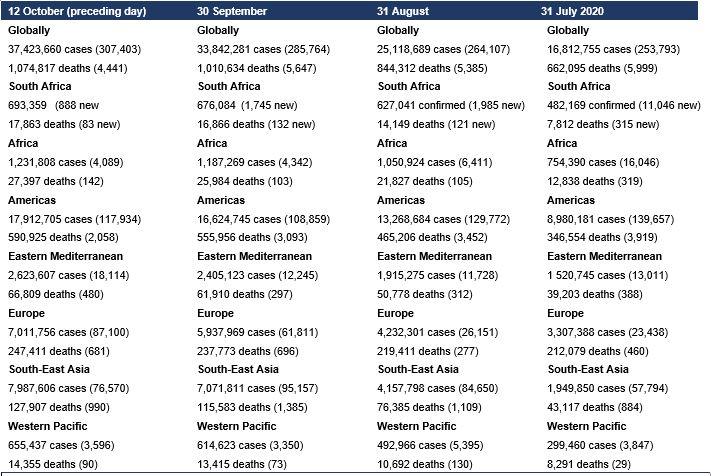
Source: WHO, NICD
Economics and markets
- Doubt and uncertainty are familiar emotions that often manifest in erratic behaviour
- The most apparent is the backwardation of the VIX curve
- Despite renewed instances of covid in European and US hotspots, global markets are becoming less distracted by the virus overhang
- Vaccine setbacks spark concern, dampening optimism from overnight tech rally in the US
- Risk currencies stuck in a holding pattern
- USD/ZAR opens at 16.51; EUR/ZAR at 19.50; GBP/ZAR at 21.57 and CNY/ZAR at 2.44.
My three-year-old woke up in a panicked state at 4am this morning, concerned that we had run short of milk. “Milk?”, I asked. “Yes”, he replied, “we need to go to the shops…now”. It took more than an hour to convince him that our dairy inventory was perfectly well stocked, that retail outlets have daylight trading hours and that it was still sufficiently dark enough for him to sleep. I, on the other hand, was wide awake, which meant only one thing…coffee!
Doubt and uncertainty are familiar emotions that often manifest in erratic behaviour. For my three-year-old, it’s pre-dawn conversations; for investors, its daily positionings that often lead to distortions. The most apparent is the backwardation in the VIX curve, which is traditionally upward-sloping, implying that investors are willing to pay more to hedge themselves against short-term volatility. This is prudent considering the plethora of risks on the horizon – but Bloomberg, which notes the dislocation, stresses a point made by S&P that backwardation of this magnitude has happened at most five times since 2005. That speaks to an unprecedented level of uncertainty akin to the GFC!
Despite renewed instances of covid in European and US hotspots, global markets are becoming less distracted by the virus overhang. Instead, participants are consumed by the possible outcomes of the US elections, the prospect of delayed or underwhelming Treasury stimulus and setbacks in the development of an effective vaccine. The culmination of those fears is becoming more apparent as the day progresses, dampening a remarkable overnight tech rally in the US, which propelled the Nasdaq and S&P to multi-week highs.
Momentum slowed towards the end of the US trading session as markets got wind that a Johnson and Johnson vaccine study had hit a stumbling block. This has proved to be a major sticking point for European markets this morning as regional virus cases rise. Asian stocks are less perturbed, feeding off the US tech optimism and fuelled by further evidence of a sustained recovery in China. Investors are increasingly looking to Asian bourses given attractive valuations and relatively stronger economic growth prospects. The sustained interest has contributed to China’s astronomical market capitalisation, which has surpassed the US$10 trillion mark (roughly 17% of global stocks).
Despite this morning’s fanfare post the Columbus Day holiday in the US, risk currencies are caught in a holding pattern. The lack of direction is evident in the rand’s opening levels which have been relatively unchanged over the last few days. The spot trading range against the greenback has narrowed to 10c on either side of 16.50. The President’s address on the economic reform programme on Thursday might spur a break of the 16.40 support level if the government’s proposals are deemed achievable. However, markets remain sceptical of SA’s fiscal position, keeping even the hungriest of yield hunters at bay (refer to the local rates section).
With Day 2 of the IMF annual meetings underway, I’m tempted to pour my fourth cup of coffee. Now where’s the milk?
Nema Ramkhelawan-Bhana
Local rates
With the US celebrating Columbus Day yesterday, global markets spent the day trading in illiquid markets, with turnover significantly lower across most instruments. SAGBs managed a measly R11bln turnover day. What was surprising, however, was that bonds managed to gain some ground the day before the auction. SAGBs strengthened between 3-6bps across the curve, with local and offshore clients seen as better buyers. This should bode well for the SAGB auction today.
National treasury comes to market issuing R186s, R2030s and R2044s. Given the low delta auction and the favourable environment for SAGBs now, this auction should fare well, with yields clearing 1-2bps through market mids. A strong auction will provide support for SAGBs for the rest of the trading session as there is little data to drive price action. The market is focused on the budget next week and the economic recovery program that Ramaphosa will unveil on 15 October – that’s why we’ve seen a lot of disinterest in SAGBs this past month. A lot of negativity is already priced into SAGBs and the market has come to terms with the fact that a delicate balancing act is required to stimulate growth while still keeping debt in check. The question is what debt to GDP level is acceptable for markets? And has enough negativity been priced into SAGBs at present?
Michelle Wohlberg
loading form...