
RMB Markets Daily: Uncertainty abounds
Global: US election day has arrived
SA: Manufacturing continues post-lockdown recovery
Rand: Likelihood of a volatile trading day high
Local rates: Event risk to keep flows light
What to watch today
- US Factory Orders
- US Durable Goods Orders
Covid-19 update
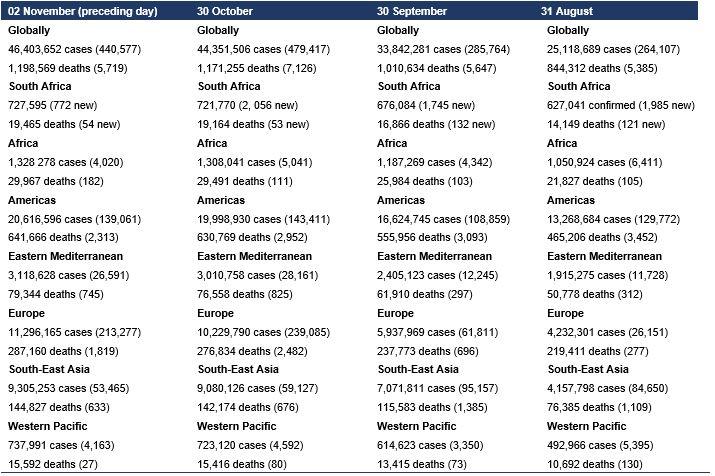
Source: WHO, NICD
Economics and markets
- US election day has arrived and early votes amount to about 70% of the total turnout for the 2016 elections, pointing to increased voter participation.
- Russia may push for the OPEC+ planned paring of production cuts to be pushed out a further three months, which saw Brent crude oil’s opening level jump to over US$39/bbl.
- This morning’s optimism on Asian markets could fade fast over US election news and increasing concerns over a double-dip recession in Europe.
- The rand will probably display heighted volatility during this period, although it remains fairly solidly in the 16.20-16.50 trading range, for now.
- Pointing to the extension of 3Q20’s robust recovery in domestic economic activity to the fourth quarter is the move of SA’s October manufacturing PMI to 60.9 index points.
- USD/ZAR opens at 16.22; EUR/ZAR at 18.90; GBP/ZAR at 20.93 and CNY/ZAR at 2.42.
It is a quiet day for data releases, which is a good thing, as all focus will be on the west – today is, at long last, US election day. Interestingly, around 97 million early votes have already been cast, apparently equivalent to about 70% of the total number of votes cast in the 2016 elections. Thus, total turnout (including absentee, early and postal ballots) for these elections is on track to surpass 2016’s. There is a strong likelihood though that election day turnout could be a bit lower than normal due to fears over the continued spread of covid-19. The US’ new infection count on Sunday breached 99,000 people, but fortunately moderated to a little over 80,000 yesterday. The extraordinary level of early votes could be a significant reason for a slower than normal results release, suggesting that the vote may not be called by the end of today, but will also be a central focus for possible contestation of the results. There have been numerous polls tracking who the winner will be, but it is today’s poll that ultimately matters, and my sense is that the outcome remains clouded by uncertainty.
While it feels like the focus this week will be strongly on the US, the world does not stop turning. A stark reminder of this is yesterday’s terrorist attack in Vienna, Austria, when gunmen unleased fire in a number of public areas in the city as residents enjoyed a last night out prior to returning to lockdown. The reason for this attack remains unknown. As many European countries go into lockdown this week, it is worrying that social distancing may not be the only concern for residents either enjoying their last moments of freedom or those making final preparations for the looming lockdown.
Other news out yesterday was that Russia may push for the OPEC+ planned paring of production cuts, scheduled for January 2021, to be pushed out a further three months, probably in response to renewed lockdown trends which will keep demand for oil low. This news has pushed the price of Brent crude oil to open at US$39.26/bbl, substantially higher than the sub-US$36/bbl opening for the week. Markets will probably experience heightened volatility over the next couple of days of trading as US results start trickling in. Some kind of stability should be re-established once the result is called. This said, Asian markets are reflecting optimism, with the Hang-Seng up over 2.3%, the ASX up 1.9% and the Chinese and Indian bourses up over 1.2%, although markets can change tack pretty fast should a reason for the optimism to fade arise. This may not only relate to US election results as lockdowns in Europe are increasing the concern that the economic recovery from the covid-19 shock will be slower, with the growing probability of a double-dip recession for many economies. The rand will probably display heighted volatility during this period, although it remains fairly solidly in the 16.20-16.50 trading range, for now.
A possible boost to economic confidence, and pointing to the extension of 3Q20’s robust recovery in domestic economic activity to the fourth quarter, is the move of SA’s October manufacturing PMI to 60.9 index points. This result is more than double the low of 30.3 recorded in April and the highest level since the inception of the survey in September 1999. A word of caution though is that respondents are speaking to manufacturing activity approaching its pre-covid levels – not surpassing it. Further, the expected business conditions over the next six months ticked slightly lower, reflecting concerns about the impact on demand of new waves of covid-19 in Europe and the US, and possibly concerns that SA could follow. Thus, a record high does not mean record high manufacturing production, but perhaps rather that the manufacturing sector has seen a solid recovery from the second quarter’s virtual shutdown. How long this will last and how much further it can go will remain uncertain and will rely on SA’s ability to avoid further lockdowns.
Siobhan Redford
Local rates
As if we haven’t had enough drama this year, this week is set to be the most volatile one yet. With US elections, a Fed meeting and the latest US job numbers on the cards, it’s no surprise that turnover yesterday in the SAGB market was a measly R13bn. We saw the bond curve under steepening pressure as primary dealers made space to take up today’s auction. We’ve seen a disconnect in the bond and currency markets, with the rand trading surprisingly well – despite the bearishness in the bond market, which leads us to believe that SAGBs are pricing in local fundamentals while the rand is trading as a risk proxy for macro factors.
The National Treasury will issue R2030s, R2035s and R2040s today. With these bond yields looking attractive after yesterday’s sell-off and the bonds on offer providing a fair amount of duration over the US elections, we might see some opportunistic bidding in today’s auction. Yields are expected to clear at or slightly through market mids. Trading post auction is expected to be light as investors await more clarity from the US elections.
Michelle Wohlberg
loading form...