
RMB Markets Daily: Trick or treat
Global: Abundant event risk
SA: Investors question long-term implications of MTBPS
Rand: Battered and bruised after a volatile trading week
Local rates: Curve steepening points to budget fears
What to watch today
- JN Tokyo CPI (y/y)
- UK Lloyds Business Barometer
- GE GDP SA (q/q)
- EC Unemployment Rate
- EC GDP SA (q/q)
- EC CPI (m/m)
- SA Trade Balance Rand
- SA Monthly Budget Balance
- US Personal Income
- US Personal Spending
- US MNI Chicago PMI
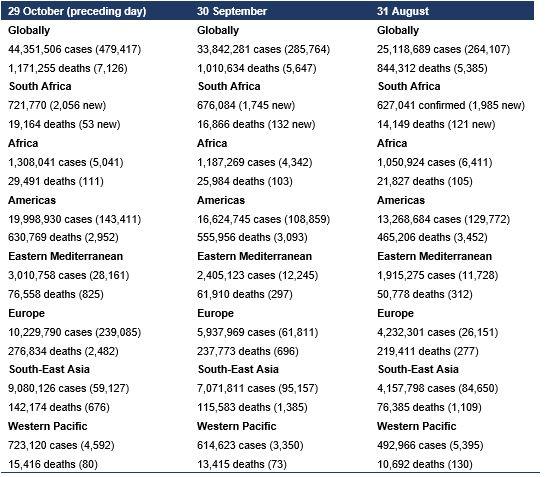
Covid-19 update
Source: WHO, NICD
Economics and markets
- Much like trick-or-treating, investors are going door to door seeking sugary and high-alpha delights.
- They might struggle amid all the spookiness of US elections, resurgent covid-19 cases in Europe and varying degrees of fiscal intervention across the globe.
- Dour sentiment despite upbeat five-year CCP plan.
- EM universe battered and bruised after a tough trading week.
- The US elections is chief among the many risks next week.
- SA rand losses and curve steepness express worries over longer-term outlook.
- USD/ZAR opens at 16.39; EUR/ZAR at 19.14; GBP/ZAR at 21.19 and CNY/ZAR at 2.44.
My grandad owned a fruit and vegetable shop, which meant that many of my formative years were spent watching my elders carve pumpkins into quarters for sale. Sculpting menacing faces into flat white pumpkins or habit squash (common to SA) was a most bizarre practise for us. Halloween was a familiar celebration, at least on television. But dressing up as ghosts and ghouls and extorting candy from unsuspecting neighbours wasn’t a common practise, at least in my part of town. Fast-forward several (undisclosed) years and I find myself stockpiling individually-wrapped sweets for the army of costumed children that is set to descend on my pumpkin-laden doorstep tomorrow afternoon. How times have changed.
Much like trick-or-treating, investors are going door to door seeking sugary and high-alpha delights. They might struggle amid all the spookiness of US elections, resurgent covid-19 cases in Europe and varying degrees of fiscal intervention across the globe. With little care for the rebound in US and European third-quarter growth, and even less concern over the CCP’s fresh five-year plan, markets are starving themselves of risk, showing apprehension ahead of a mammoth week characterised by wads of data and key rate decisions.
Voting might only be open to the 328 million odd Americans, but the presidential vote on 3 November has universal implications. Not least for China, which acknowledged the “complicated international situation” during the CCP’s four-day plenum and the need to foster new international relationships to safeguard its supply of strategic resources. This, following debilitating disruptions to value chains since the onset of the trade wars and covid-19. A boon to resource-rich countries, though an added element of tension with traditional partners in the West. A new US administration, which the polls are favouring, might change the tone of discussions between Washington and Beijing, though the negotiated terms of the trade compact and restrictions on tech firms will probably stand.
That isn’t going to deter China from pursuing innovation as it seeks to become self-sufficient as part of the modernisation of economic and industrial structures. Its dual circulation strategy, details of which are scant, seems to hinge on technological dominance as the country works towards narrowing rural and urban inequalities to create a more balanced and well-rounded society. Complementing the need for quality (rather than expeditious) growth is further development of the capital markets and crowding in of the private sector, particularly those involved in fintech, ecommerce and technology. Next week’s listing of Ant Group, whose retail book is already 872 times oversubscribed, shows that investors are willing to risk greater scrutiny of fintech firms for a stake in China’s biggest payments platform.
The sentiment towards US tech companies is less jubilant, at least over the last week. Despite outpacing revenue expectations, their results tripped up investors amid worries that many had missed other key metrics. The dour outlook extended from US equities markets to Asia and Europe as they progressively opened to face the final trading day of October. Stressing the failure of EU leaders to suppress the most recent flare up in virus cases due to fear of political backlash, German Chancellor Merkel highlighted the risk of an acute national health emergency if strict measures are not reimposed.
The culmination of these events is less than ideal for risk assets. Both the MSCI’s measures of aggregate EM equities and currency performances are trading in the red, bruised by global and idiosyncratic risks. Aside from a handful of Asian currencies, with the yuan at the forefront, the EM FX universe is licking its wounds. The rand is no exception, losing its handle on 16.30 against the greenback and trending back towards 16.50 as EUR/USD falters. Perhaps a function of more than just the global backdrop, as the market fully digests the outcomes of the MTBPS, SOE funding needs and the credibility of anti-graft reforms. Realities that are more fully reflected in the pricing of the nominal bond curve (refer to the local rates section).
All that’s left to be said is trick-or-treat, I hope that post elections, the market gives us something good to eat.
Nema Ramkhelawan-Bhana
Local rates
The shape of a government yield curve often reflects longer-term investor confidence, not only in government policies and strategy but, most importantly, the actual ability to repay debt. It should therefore be no surprise that post budget, the local curve has steepened up by some 10-15 points again as investors show their concerns over the fiscal situation SA faces for the next few years. Although not quite back to its recent highs of 459 points, the R2048/R186 spread is trading just below 455 again after having got below 440 points with some misplaced hope that the National Treasury would be able to reduce issuance to some degree and take the pressure off the domestic market. Offshore investors have also continued selling bonds across the curve, with around R3bn in sales yesterday and another negative month in the offing in October as a whole.
On the issuance front, we have the weekly ILB auction as well today with R2bn on offer across the I2025/2033/2050 spread of bonds. Given the heightened yields and continuous support that these instruments seem to be getting every week, we expect the auction to clear at or slightly above last night’s MTM levels of 3.02/4.77 and 4.9025, respectively.
Watch out for local Trade and Government Budget numbers at 14:00 as well as a raft of US data out at 14:30.
Enjoy the weekend!!
Deon Kohlmeyer
loading form...