
GM Daily: Tit for tat
Global: Trump signs new relief executive order, while US-China tensions escalate
SA: Data to show extent of 2Q20’s economic contraction
Rand: Caught in the lira’s contagion
Local rates: Quiet start to the week
What to watch today
- JN Trade Balance BoP Basis
- UK Jobless Claims Change
- GE ZEW Survey Expectations
- EC ZEW Survey Expectations
- SA South Africa Unemployment
- US NFIB Small Business Optimism
- SA Manufacturing Prod NSA (y/y)
- SA Manufacturing Prod SA (m/m)
- US PPI Ex Food, Energy, Trade (y/y)
Covid-19 update
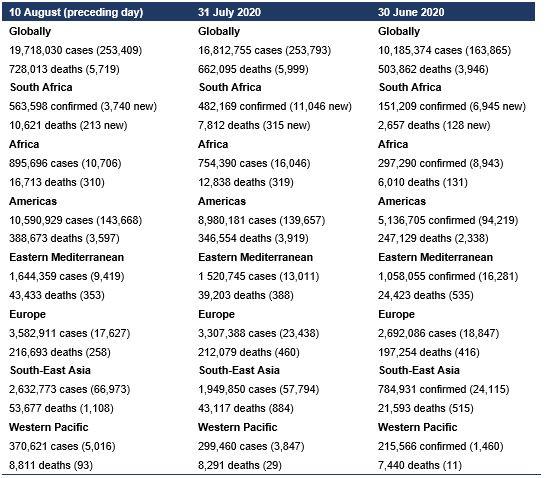
Source: WHO, NICD
Economics and markets
- Global equity stocks are up as investors shrug off escalating US-China tensions on hopes of US stimulus.
- President Trump signs a covid-19 relief package executive order, but concerns over affordability are raised.
- US-China tensions escalate as China imposes sanctions on US officials in retaliation over similar moves by the US.
- Local data out this week will provide a clearer picture of the extent of 2Q20’s economic contraction.
- USD/ZAR opens at 17.76; EUR/ZAR at 20.86; GBP/ZAR at 23.13 and CNY/ZAR at 2.55.
Global markets will probably be mixed this week as investors weigh against US-China tensions and US stimulus measures. Global equity markets closed in the green on Friday, with the positive sentiment filtering through to this week. The S&P was up 0.3% yesterday, while the Hang Seng and Nikkei gained 2.4% and 1.8%, respectively, in the early morning Asian trading session.
Sentiment is buoyed by better-than-expected NFP data published last week Friday, and news of stimulus measures in the US. This comes as President Trump signed an executive order over the weekend seeking to provide relief to workers, businesses and local governments after talks on a new relief package between the Trump administration and Democratic leaders collapsed on Friday. However, both Republican and Democratic governors have expressed concerns over the affordability of the relief measures and have urged officials to resume negotiations.
Meanwhile, US-China tensions continued to escalate ahead of Saturday’s meeting between US and Chinese trade officials to review the first six months of the Phase 1 trade deal. On Monday, China imposed sanctions on 11 US officials, a tit-for-tat move following similar sanctions imposed on Chinese and Hong Kong officials by the US over their role in imposing a draconian security law in Hong Kong.
In currency markets, the rand closed Friday’s trading session 3.3% weaker against the US dollar on a weekly basis. The rand’s performance was worse than the average of EM currencies, with the MSCI for EM currencies down 1.5%, but better than the Turkish lira’s slide of 4.4%. The rand continued to depreciate on Monday, caught in the lira’s contagion, to close at 17.69 against the greenback. In the absence of news to improve EM risk sentiment, the rand will probably remain on the back foot.
On the data front, globally, the focus should be on the UK and eurozone’s second quarter GDP data out on Wednesday and Friday. For the US, we have inflation, retail sales and industrial output data for July due for publication on Thursday. These will make for interesting reading on the strength of economic recovery in the third quarter. Sentiment indicators continue to point to a V-shaped recovery, with the risk that a second wave of infections could dampened the pace of recovery.
Locally, while covid-19 restrictions continue to pose challenges for Stats SA’s data collection, the agency will publish its much-awaited high-frequency data this week, which will provide a clearer picture of the extent of 2Q20’s economic contraction. Data published so far indicates that GDP probably contracted by over 30% q/q SAAR in 2Q20. However, the high-frequency data captures about 40%-50% of GDP, reflecting uncertainty about how the other sectors that we have no sight of performed. The manufacturing data for May and June will be published on Tuesday, while retail sales and mining output for June will be out on Wednesday and Thursday. On a month-on-month basis, we expect positive prints, while on a year-on-year basis activity should continue contracting, albeit to a lesser extent compared to the prior months.
Mpho Molopyane
Local rates
Friday's flows were muted, which is what we'd typically expect from a Friday before the long weekend. Bond yields tracked lower after non-farm payrolls surprised higher than expected and gave risk assets a boost. This price action is encouraging given that the market walks into another bond auction today and seems to have enough space to absorb another R6.6bn in bonds. The yield curve closed the day marginally steeper driven by gains in the front end of the curve. The ILB auction also fared well on Friday as the National Treasury managed to allocate the full R2bn on offer with the I2029s and the I2050s clearing through MTM levels.
With risk assets mildly positive overnight, bonds should open up better bid ahead of this morning's auction. The National Treasury will issue R2032s, R2037s and R2044s. This is the first auction since the special adjustment budget where all the bonds on offer are duration heavy. The bond curve has traded exceptionally well since the announcement of this longer-dated auction, so the auction should fare well today as market participants are clearly in need of longer-dated stock. With very little data out on the local front, bonds will take their cue from the auction participation and a strong auction should result in a bond rally.
Michelle Wohlberg
loading form...