
Global Markets Daily: Tightening the purse strings
Global: Reverting to safe havens as covid concerns deepen
SA: Wednesday’s Special Adjustment Budget under scrutiny
Rand: USD/ZAR stranded as fears of a second wave intensify
Local rates: Liquidity remains a challenge
What to watch this week
Monday
- CH 1-Year Loan Prime Rate
- EC Consumer Confidence
- US Existing Home Sales
Tuesday
- JN Jibun Bank Japan PMI Mfg
- SA Leading Indicator
- GE Markit/BME Germany Manufacturing PMI
- EC Markit Eurozone Manufacturing PMI
- UK Markit UK PMI Manufacturing SA
- SA South Africa Unemployment
- US Markit US Manufacturing PMI
- US New Home Sales
- US Richmond Fed Manufact. Index
Wednesday
- JN PPI Services
- GE IFO Business Climate
- SA CPI
- US MBA Mortgage Applications
- SA Retail Sales
- US FHFA House Price Index
Thursday
- GE GfK Consumer Confidence
- SA PPI
- US Wholesale Inventories
- US Retail Inventories
- US Durable Goods Orders
- US GDP Annualized (q/q)
- US Personal Consumption
- US Initial Jobless Claims
- US Continuing Claims
- US Kansas City Fed Manf. Activity
Friday
- JN Tokyo CPI
- US Personal Income
- US Personal Spending
- US University of Michigan Sentiment
Covid-19 update
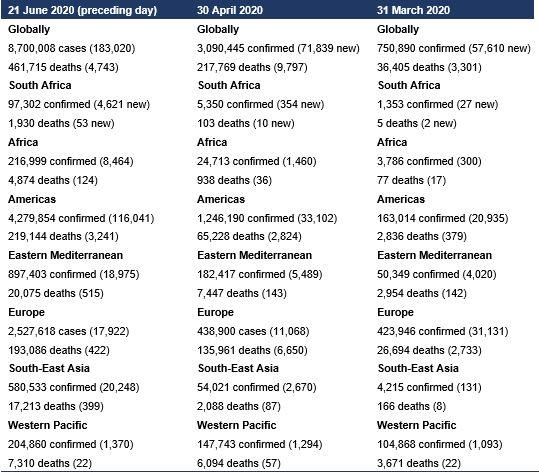
Source: WHO, NICD
Economics and markets
- The onset of covid-19 has placed an immeasurable burden on the state’s already bare coffers.
- Our expectation of a widening in the budget deficit to c.-14% of GDP, from February’s -6.8%, is fixed on the deterioration in the macroeconomic landscape.
- Market participants are understandably nervous, applying caution ahead of Wednesday’s announcement.
- The rand market is as guarded, battling to overcome local and global challenges.
- USD/ZAR opens at 17.41; EUR/ZAR at 19.53; GBP/ZAR at 21.40 and CNY/ZAR at 2.46.
Economists thrive on big risk events. Perhaps thrive is the incorrect word – agonise is more of an accurate description. While we might not huddle in a small boardroom this week for the tabling of the Special Adjustment Budget, our collective angst should transcend virtual boundaries. The onset of covid-19 has placed an immeasurable burden on the state’s already bare coffers, forcing the National Treasury to reshape its spending bill to accommodate economic interventions. Much of the adjustment will occur in the current financial year, with amendments to the outer two years to be set out in the MTBPS in October.
Our expectation of a widening in the budget deficit to c.-14% of GDP, from February’s -6.8%, is fixed on the deterioration in the macroeconomic landscape and its associated impact on tax revenues. Potential unplanned SOE support and an unlikely rationalisation of the wage bill present quite a conundrum for the NT. The resulting fiscal slippage, though, probably won’t demand additional market issuance, as multilateral institutional support, alike to the US$1bn afforded to SA by the New Development Bank, and a drawdown in cash reserves are viable funding options. The upshot is that SA’s debt trajectory continues to worsen, with the NT warning that it could balloon to a whopping 113% of GDP by 2028/29!
Market participants are understandably nervous, applying caution ahead of Wednesday’s announcement. April’s CPI data, which is scheduled for release ahead of the budget, is yet another thorny issue for investors given the challenges in data collection over the lockdown period. Deflation is still firmly entrenched, though the actual year-on-year figure presents considerable risk to the ILB market.
The rand market is as guarded, battling to overcome local and global challenges. Worries over a second wave continue to grow as new cases surface across the globe. In an appearance late last week, the WHO regional director for Europe quoted a startling statistic: “A study by The Lancet has revealed 22% of the global population – that’s 1.7 billion people around the world – have at least one underlying condition that puts them at increased risk of serious illness if infected with covid-19.” The situation could be far more frightful than we expect.
The risk rally has fizzled as a result, leaving markets adrift this morning as investors retreat to safe havens. Gold and US treasuries are the natural beneficiaries, while EM currencies risk further weakness. USD/ZAR is stranded at 17.36, with short-dated implied volatility on the pair continuing to climb.
Like the market, parliament will be abuzz this week, not least because of the supplementary budget. Ministers of the economic cluster and Deputy President Mabuza will take to the podium to answer questions on Tuesday and Thursday respectively, though their musings might be lost among all the budget buzz. As lockdown measures are progressively relaxed, SA’s rates of transmission will be scrutinised. At more than 97,300, our total cases are now 45% of Africa’s total. We cannot begin to contemplate a second wave as we still await a peak in the first.
Nema Ramkhelawan-Bhana
Local rates
Not the greatest of weeks from a trading activity perspective, with Friday probably the quietest day we’ve seen in a while. There was tiny buying interest for R2040 and R2030s from local real money, while fast money accounts expressed cares in the R186s and R2035s. The interest rate derivates market remains non-existent, but we did see interest in the 20-yr swap, though nothing in the FRA and options spaces at the moment as the battle for decent liquidity continues.
The currency has come back somewhat this morning after fiddling with the 12.50 level overnight, and is currently trading at Friday’s close around 17.35. The one-month implied volatility is middling at 18.38% ahead of next month’s monetary policy committee meeting. The weekly continues to prove an uphill battle, with Friday’s linker auction being no exception – the I2025s cleared auction at 3.75 with a bid-to-cover ratio of 1.10, the I2038s cleared auction at 4.56 with a bid-to-cover ratio of 2.28, while the I2050s cleared auction at 4.61 at a bid-to-cover ratio of 1.92. Tomorrow, the National Treasury will be issuing the following SAGB stock: R2030, R2035 and R2048s.
Tebogo Mekgwe
loading form...