
Global Markets Daily: The hippo and the aloe ferox
Global: Risk appetite lost amid overwhelming fears of a second wave
SA: NT takes up the herculean task of stabilising SA debt
Rand: At odds with the local bond markets as global risk appetite sours
Local rates: Positive budget news on issuance spurs bond rally
What to watch today
- GE GfK Consumer Confidence
- SA PPI
- US Wholesale Inventories
- US Retail Inventories
- US Durable Goods Orders
- US GDP Annualized (q/q)
- US Personal Consumption
- US Initial Jobless Claims
- US Continuing Claims
- US Kansas City Fed Manf. Activity
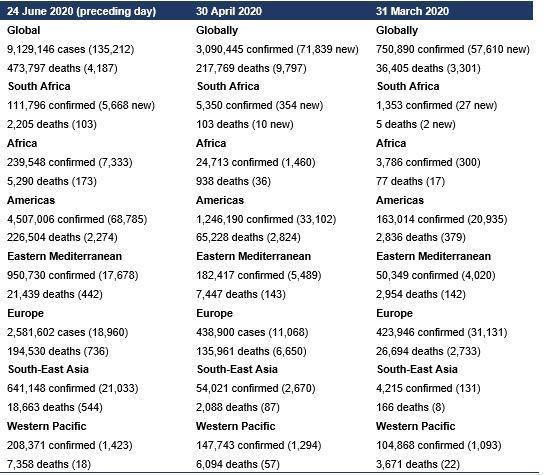
Covid-19 update
Source: WHO, NICD
Economics and markets
- Borne of unusual and unplanned circumstances, the Special Adjustment Budget or SAB focused on the reclamation of fiscal credibility.
- Bold changes are required to the current fiscal year’s metrics.
- Revenue shortfall is substantially worse than we had forecast.
- Budget surprises the market positively relative to its rather dire expectations.
- Still a healthy air of scepticism over whether the NT will follow through on its proposals.
- The rand is at odds with its local bond counterparts as global determinants weaken, suggesting upside on the rand cross today.
- USD/ZAR opens at 17.37; EUR/ZAR at 19.56; GBP/ZAR at 21.60 and CNY/ZAR at 2.45.
A curious title. Though we expect nothing less from the tabling of a national budget. A resolute, though understandably fatigued Minister Mboweni outlined changes to the fiscal framework yesterday. Borne of unusual and unplanned circumstances, the Special Adjustment Budget or SAB (the irony would be apparent to beer enthusiasts) focused on the reclamation of fiscal credibility.
Conditions have not been kind to the minister’s beloved aloe ferox, as SA battles recessionary conditions and an untenable level of indebtedness. For the minister, debt stabilisation is a herculean task, and a necessary one if SA is to eventually prosper.
To close the mouth of the hippopotamus (narrow the exorbitant budget deficit), bold changes are required to the current fiscal year’s metrics. Covid-19-led increases to non-interest expenditure equate to R36bn, almost half of what we anticipated. And yet, the revenue shortfall is substantially worse than we had forecast. At R304bn, the deficit between actual and planned receipts reflects the NT’s worst-case scenario aligned to a loss of income in personal and corporate income taxes, VAT and duties.
The outcome? A widening in the main budget deficit to 14.6% in FY20/21, 6ppt higher than the estimate that was bandied about after the Nedlac presentation last week. A narrowing to 9.3% and 7.7% in FY21/22 and FY22/23 is conditional on higher revenue collections. This would require tax revenue to recover at a more hurried pace than the tax base (i.e. GDP growth). Tough, even with the proposed tax measures this year and increases touted for the next. This brings us to the issue of fiscal sustainability. For debt to stabilise at 86.8% in FY24/25, spending must be cut by an additional R230bn over FY21/22 and FY22/23, with further rationalisation still required in FY23/24. Both optimistic and challenging to attain.
The budget surprised the market positively relative to its rather dire expectations: while the revenue shortfall was worse than consensus, the SAB at least renders the estimate as credible, and the expenditure overrun was lower than anticipated. Despite little reference to SOE reform or the much-debated zero-based budgeting, investors’ immediate concerns were allayed. Details regarding the actual path to fiscal consolidation and economic reform are deferred to the MTBPS. No pressure!
At USD/ZAR17.46, you’d be doubtful of the sentiment expressed above. Bond yields, however, are far more expressive of the positivity (refer to local rates commentary), though there is still a healthy air of scepticism over whether the NT will follow through on its proposals. The rand is at odds with it bond counterparts as global determinants weaken, suggesting upside on the rand cross today. Paired with the IMF’s view of a significantly deeper recession and simmering trade tensions between the US and EU, global trading conditions are far less accommodating of risk. A “massive outbreak” across Texas, and the acceleration in cases across the globe, has depressed Asian markets, following a 2.6% loss on the S&P index.
The Fed is concerned. Despite calling for a strong 2H20 US recovery, James Bullard still views this “as a period of tremendous uncertainty and tremendous risk”. Comforting words to an unnerved market (insert roll of the eyes here). Progressively reopening economies was always a risk to the flattening of the global curve, but in keeping with our odd references, perhaps the chickens have come home to roost.
Nema Ramkhelawan-Bhana
Local rates
The local bond market grabbed at the small slivers of positive news in yesterday’s budget speech by Minister Mboweni with some enthusiasm. With no increase in domestic issuance, and signs that the greenshoe option may be reduced, the market managed a 15 point rally post-budget, with the yield curve flattening around 5 points to the R186 as well. This did not really take away from the fact, though, that SA Inc is in real trouble, with fiscal problems pre-covid now being exacerbated. The minister has a tough road ahead to reduce expenditure and prove to the world that SA is capable of living within its means and rectifying what is becoming a serious debt/GDP problem.
Flow wise, foreigners were still sellers on the day but only to the tune of around R500m with most of the selling across the curve, but interestingly still buying R2030s. The R2030 seems to be becoming the new benchmark bond for offshore investors as total trade was around R4.5bn, whereas it was only R1.5bn in the traditional benchmark R186. Local investors helped flatten the yield curve yesterday, buying over R1.2bn of R2048s.
SA PPI for April is out this morning at 11:30am, with 1.9% expected y/y. Watch out for a whole host of US data out this afternoon, including Q1 GDP.
Deon Kohlmeyer
loading form...