
GM Daily: Taffy pulling
Global: US dollar and equities being stretched in opposite directions
SA: Stage 2 load-shedding continues into Wednesday
Rand: Broadly supported by a weaker US dollar
Local rates: Auction well supported
What to watch today
- JN Trade Balance
- UK CPI
- UK Retail Price Index
- UK PPI Output NSA
- EC ECB Current Account SA
- UK House Price Index
- EC CPI
- US MBA Mortgage Application
- US FOMC Meeting Minutes
Covid-19 update
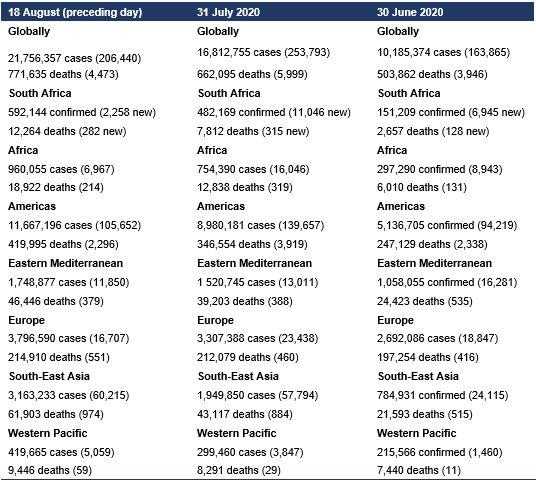
Source: WHO, NICD
Economics and markets
- At almost pre-pandemic highs, the S&P is soaring while the US dollar index sinks to its lowest level since 2018.
- Fundamentals remain weak, calling into question the sustainability of the equities run.
- The Fed remains alive to the possibility of further economic distress.
- We expect that the dollar’s demise will be a slow process.
- Markets are frothy, but there are few signs of outperformance as the US-Sino trade deal is still a cause for concern.
- Eastern Europe has become the hotbed of socio-political unrest.
- USD/ZAR opens at 17.32; EUR/ZAR at 20.66; GBP/ZAR at 22.93 and CNY/ZAR at 2.50.
Like the pulling of taffy, US assets are being stretched in opposite directions. At almost pre-pandemic highs, the S&P is soaring while the US dollar index sinks to its lowest level since 2018.
Aerating candy makes it lighter and chewier. Adding tiny bubbles to financial markets can be as satisfying, provided they don’t burst. As the S&P 500 tests yet another high, the momentum-based argument is giving way to the belief that the rally is being sustained by quality stocks. Fundamentals, though, remain weak, calling into question the sustainability of the equities run. A market bubble, perhaps? Hardly, as the current environment lacks the universal optimism about future profits and mammoth share issuance by new companies that characterised previous escalations in stock prices. Market behaviour though signals a definitive turn in US economic fortunes that isn’t reflected in the economic data. The Fed remains alive to the possibility of further economic distress, noting that diminishing interest rate differentials with the EU are a catalyst for US dollar weakness. The minutes of the committee’s last meeting should allude to this point and, more importantly, reinforce the need for accommodation.
US market conditions have set the tone for risk trading today. Markets are frothy, but there are few signs of outperformance as the US-Sino trade deal is still a cause for concern. While we’re accustomed to associating geopolitical tensions with the US and China, Eastern Europe has become the hotbed of socio-political unrest. Emboldened by support from the Kremlin, President Lukashenko deployed the military to Belarus’ borders with the EU, citing unspecified security threats – arguably a show of force ahead of the planned summit of EU leaders today on the disputed election. Russia’s stern warnings against foreign interference linger in the background. The strong US dollar undertone is a possible mask to the broader impact on Eastern European currencies, which continue to eke out gains. The lira is a possible exception as the alliance of convenience between Turkey and Venezuela comes under scrutiny by the west.
Another necessary distraction for the Republicans, perhaps, as the Democrats continue their assault on the sitting President during their virtual convention at which Joe Biden was confirmed as the presidential nominee.
The rand continues to trade in a broad range, teetering at USD/ZAR17.30. In our base case, we expect that the dollar’s demise will be a slow process and that it will retain its safe-haven status in the short to medium term, however, uncertainty about the US, its handling of the health crisis and growing twin deficits should see the currency trade in a wider range. We expect the DXY index to trade around 95, falling close to 90 during times of risk-on and 98 during times of risk-off, and EUR/USD trading around 1.15 on average over the remainder of 2020. The dollar should weaken in 2021, to trade around 1.20.
With international travel restrictions still in place, you might be less concerned about the rand price of a soft drink overseas. If you’re curious as to where you might holiday locally under alert level 2, then we’d suggest listening to the briefing by SA’s tourism minister at 2pm. There’s little else of interest on the local calendar, though it’s probably your load-shedding schedule that you’re most concerned by as Stage 2 continues into today. Rotational cuts are fast becoming commonplace as delays to Eskom’s planned maintenance programme, paired with breakdowns at several generation units, force the utility to remove chunks of demand from the national power system. Spare a blanket or three for those less fortunate, surviving both the dark and the cold.
Nema Ramkhelawan-Bhana
Local rates
The R186 displayed its prowess in yesterday’s weekly nominal auction by printing the highest bid-to-cover ratio on the day. Going into auction, it was almost a foregone conclusion that the R2032 would clear relatively stronger than market and present the highest bid-to-cover ratio given its take-up in the past few nominal auctions. This, however, did not materialise, and in fact the contrary occurred.
Yesterday, the R186s cleared auction at 7.46 (market 7.465) with a bid-to-cover ratio of 3.34, then R2032s cleared auction at 10.22 (market 10.215) with a bid-to-cover ratio of 2.236, while the ultralong (R2048s) cleared auction at 11.47 (market 11.48) with a bid-to-cover ratio of 2.236. Although the nominal auction was well supported, flows this week have been relatively light. The curve has come under mild flattening pressure with the back end of the curve maintaining its bid tone. This while 3-month Jibar is trading below the repo rate. The rand has strengthened roughly 20 cents against the greenback this morning, with the volatility levels also coming off.
Good luck out there.
Tebogo Mekgwe
loading form...