
GM Daily: Sometimes it is necessary to go back before we can move forward
Global: Markets taken by giddy optimism over global recovery
SA: Medical Research Council expects medical resources to be freed up with new restrictions
Rand: Local unit tests stronger levels against greenback but open to volatility
Local rates: Stronger rand this morning
What to watch this week
Monday
- US Monthly Budget Statement
- GE Wholesale Price Index
Tuesday
- UK Monthly GDP
- UK Industrial Production
- UK Manufacturing Production
- GE CPI
- EC Industrial Production WDA
- SA Mining Production
- SA Mining Production
- US CPI
Wednesday
- JN Tokyo Condominiums for Sale
- UK CPI
- UK Retail Price Index
- SA CPI
- UK House Price Index
- US MBA Mortgage Applications
- US Import Price Index
- US Export Price Index
- US Capacity Utilization
- US Manufacturing (SIC) Production
Thursday
- CH GDP (y/y)
- UK Jobless Claims Change
- EC Trade Balance SA
- SA PPI
- US Philadelphia Fed Business Outlook
- US Initial Jobless Claims
- US Continuing Claims
- US Net Long-term TIC Flows
- US Total Net TIC Flows
Friday
- EC CPI (y/y)
- US University of Michigan Sentiment
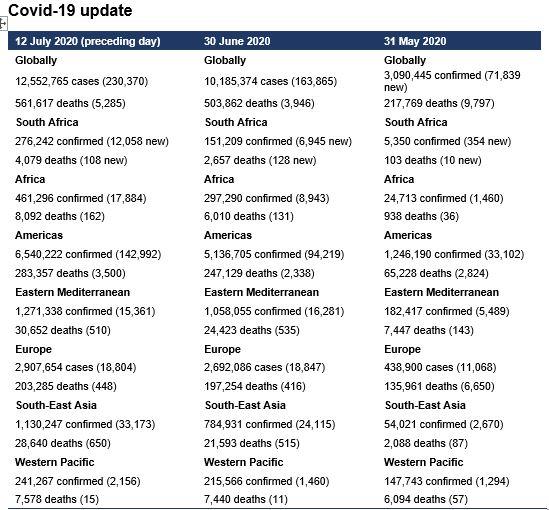
Covid-19 update
Source: WHO, NICD
Economics and markets
- Hospital admissions continue to soar, and public health facilities are overflowing in provisional hotspots.
- It’s unsurprising then that the National Coronavirus Command Council sought to reinstate certain restrictions.
- As SA’s rate of recoveries relative to total cases falls, the need for additional resources becomes dire.
- Global case rates are in their millions, and yet markets are still in risk-on mode.
- The meld of giddy optimism and a handful of data that should reflect a change in global fortunes post the covid-19 outbreak is supportive of risk assets.
- Despite the list of central bank meetings this week, the BoJ and ECB among them, global markets will be captured by one data point in particular: 2Q20 China GDP.
- USD/ZAR opens at 16.79; EUR/ZAR at 19.00; GBP/ZAR at 21.17 and CNY/ZAR at 2.40.
After 109 days of varying levels of lockdown, SA is yet to register a peak in covid-19 cases. Now among the top ten countries with the highest case rates, SA is fast becoming a global source of concern. Hospital admissions continue to soar, and public health facilities are overflowing in provisional hotspots.
It’s unsurprising then that the National Coronavirus Command Council sought to reinstate certain restrictions to reduce the alcohol-related incidents choking trauma units. In banning the sale of alcohol and reimplementing a national curfew, the Medical Research Council estimates that the time spent in general and ICU wards would be reduced by 124,000 and 46,000 days, respectively, over an eight-week period, allowing medical personnel to be redeployed to care for covid-19 patients.
As SA’s rate of recoveries relative to total cases falls, the need for additional resources becomes dire. Though harmful to the alcoholic beverage industry, the measures announced last night strike the necessary balance between the preservation of scarce healthcare resources and the furthering of economic activities. Sometimes it is necessary to go back before we can move forward.
Global case rates are in their millions, and yet markets are still in risk-on mode. It’s a matter of timing and interpretation. As economies lift from the despair of 2Q20 and data surprises to the upside, markets are more aligned to the notion of a V-shaped recovery, offsetting the potential drag that subsequent ‘waves’ could have on global productivity, with the additional policy stimulus that will be afforded to ailing economies. Citigroup’s economic surprise index, which is a gauge of whether economic data performs better or worse than consensus, reflects a consistent improvement in activity across major centres, inspiring the equities rally which continues unabated, barring a few blips. Underpinned by strong valuations in technology stocks, the global stock party could receive an additional boost from positive outlooks expressed by US multinational firms in their 2Q20 earnings reports.
The meld of giddy optimism and a handful of data that should reflect a change in global fortunes post the covid-19 outbreak is supportive of risk assets. The rand is a primary example of this phenomenon, outpacing its EM peers as the lure of positive carry trade returns, seemingly outweighing domestic risks. Blown within a whisker of USD/ZAR16.74, the currency pair will probably test 16.70, though global liquidity will begin to thin as the European summer holiday gets underway, resulting in more erratic intraday moves.
Despite the list of central bank meetings this week, the BoJ and ECB among them, global markets will be captured by one data point in particular: 2Q20 China GDP. Having led to the downturn and ostensibly the upturn, investors are eager for firm evidence of a sustainable rebound that aligns to the recent high-frequency data. That isn’t to say that all EMs will follow the same growth trajectory, but a sustained improvement in Chinese GDP does bode well for commodities prices and export demand.
A helping hand, though certainly not a panacea for SA’s fragile growth. This week will see the return of a flood, of sorts, of SA data, particularly the release of the mining production figures, CPI and PPI for May. It will be interesting to see how the mining sector performed during the month of May, which is when South Africa’s economy transitioned to lockdown level 4. The focus, though, will be on May’s CPI print. Our economists expect inflation to have declined by 1ppt to 2.0% in May relative to April’s 3.0%. This will be a substantial step down for inflation, and importantly mark the beginning of sub-lower-bound inflation prints, which we expect to extend through to 1Q21.
Nema Ramkhelawan-Bhana
Local rates
With the linker curve offering attractive rates, one would have expected higher bid-to-cover ratios in Friday’s ILB auction. The ultra-longs were middling at 5.00%, while the R202 and I2038 reached a level of 4.94% around lunchtime. Be that as it may, the ILB stock remains relatively more expensive than nominal bonds. With the back end of the curve continuing to elevate, liquidity in this market is proving very tricky, with some real money accounts opting to work orders in R50m buckets.
In the auction, I2025s cleared auction at 3.98 (market 3.94) with a bid-to-cover ratio of 1.60, the I2038s cleared auction at 4.95 (market 4.91) with a bid-to-cover ratio of 1.28, while the I2050s cleared auction at 4.97 (market 4.97) with a bid-to-cover ratio of 1.85. The National Treasury issued R500m, R745m and R755m of the I2025s, I2038s and I2050s, respectively. On the nominal end, local real money accounts were better buyers of R186s, R2040s and R2044s, while offshore accounts sold R2048s.
The rand is trading fairly strong this morning around the 16.70 level and appears to be leading emerging market strength against the greenback. The one-month and three-month implied volatilities are middling at 15.20 and 15.62, respectively.
Tebogo Mekgwe
loading form...