GM Daily: Peaks and plateaus
Global: Fed sees changes in the virus as crucial to the path of the economy
SA: Western Cape shows signs of improvement in covid-19 case numbers
Rand: Holding firm at USD/ZAR16.50 but struggling to break lower
Local rates: Offshore selling pushes yields higher
What to watch today
- JN Retails Sales (y/y)
- GE GDP SA (q/q)
- GE Unemployment Change
- EC Economic Confidence
- SA PPI
- SA Monthly Budget Balance
- GE CPI
- US GDP Annualised (q/q)
- US GDP Price Index
- US Initial Jobless Claims
Covid-19 update
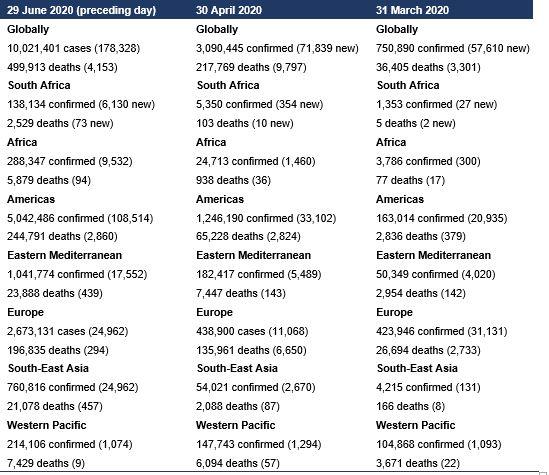
Source: WHO, NICD
Economics and markets
- The Western Cape is showing signs of improvement as the number of new infections drops meaningfully.
- Whether other hotspots will follow a similar pattern of change is unknown.
- Despite the Western Cape’s progress, the government’s risk-adjusted strategy is unlikely to change until a wholesale improvement is evident.
- June’s inflation print is testament to the continued stress on aggregate demand.
- Central banks globally continue to do the heavy lifting. Not least the Fed, which expressed a dovish tone.
- True to form, markets have interpreted the Fed’s dovish stance as supportive.
- With German employment figures on the cards today, markets will be watchful of a slight blip in EUR/USD if the data points to persistent labour strains.
- USD/ZAR opens at 16.54; EUR/ZAR at 19.51; GBP/ZAR at 21.37 and CNY/ZAR at 2.36.
After months of battling the epidemic, the Western Cape is showing signs of improvement as the number of new infections drops meaningfully. The results are differentiated though. The decline is evident in densely populated communities in Cape Town relative to further along the coast where cases surfaced at a later stage. The point, however, is that the province appears to have crossed the threshold. Stresses on testing facilities and public health resources are lessening, offering the first signs of progress in SA.
Whether other hotspots will follow a similar pattern of change is unknown. Gauteng still accounts for 36% of total case numbers, with health facilities and resources continuing to take strain. A peak is yet to form. The upshot is that despite the Western Cape’s progress, the government’s risk-adjusted strategy is unlikely to change until a wholesale improvement is evident, implying further economic malaise.
June’s inflation print is testament to the continued stress on aggregate demand. Headline CPI remained below the lower bound of the inflation target in June, printing at 2.2% y/y. Stats SA continues to outline the processes undertaken to overcome the difficulties posed by lockdown. Imputations were used once again, although the proportion of goods and services estimated using headline CPI fell from 23.7% of the basket to 8.3%. Our inflation profile remains below that of the SARB and is a vital consideration that we believe will result in the Bank cutting rates by a final 25bp in September, offering further respite to indebted consumers.
Central banks globally continue to do the heavy lifting. Not least the Fed, which expressed a dovish tone as it retained rates near zero last night. The FOMC’s messaging was clear and decisive. It pledged to use all of its tools to support a recovery from a downturn worse than the GFC. Jerome Powell highlighted “extraordinary uncertainty and a long road ahead, with more economic fallout from the pandemic”. A stark contrast to the toing and froing at the White House on fiscal stimulus, with the president’s chief of staff saying a deal is “nowhere close.”
True to form, markets have interpreted the Fed’s dovish stance as supportive. The steepening in the US yield curve captures expectations of lower-for-longer rates, while downside pressure on the trade-weighted US dollar will probably reassert following the release of what’s forecast to be a poor read of US second quarter GDP. EUR/USD’s journey to 1.18 proved beneficial to EM risk assets, though the rand has lagged the general move stronger in EM currencies, failing to meaningfully breach the USD/ZAR16.50 level. Like the case numbers in the Western Cape, the currency pair appears to have plateaued.
With German employment figures on the cards today, markets will be watchful of a slight blip in EUR/USD if the data points to persistent labour strains. The overarching benefit to the euro, however, is coordinated policy support. Patronage that the US dollar sorely lacks. This should ensure that spot rand holds firm at current levels. The 3-month implied volatility on the currency pair continues to recede as does the 6-month 25-delta risk reversal, denoting the market’s reduced expectations of erratic price swings.
Nema Ramkhelawan-Bhana
With currency markets basically treading water yesterday before the Fed’s meeting last night, the local bond market was driven more by flows than anything else. The R186 ended the day basically around 10bp weaker from the open and the curve another 5-6bp steeper.
Local investors were pretty quiet on the day, with offshore players more active and ending up better sellers to the tune of around R3bn, with most of the selling in the ultra-long end R2044s and R2048s, which steepened up the curve. By our calculations this takes them to around R2bn in net sales for the month and over R80bn year-to-date. Hardly surprising that the R2048 is some 150 points weaker than the 10% level we started at in January this year.
Another potential reason for the steepening curve yesterday was the National Treasury’s announcement of next week’s auction stocks with the shorter-maturity bonds still present in the R186 and R2032, but the addition of the R2048 as well, which does make some sense as the shorter part of the curve is growing rapidly in terms of amount outstanding (R2030 now close to R240bn already).
R186s open up at 7.59/7.57% (7.54% close) this morning with the rand slightly weaker at R16.65/US$.
Look out for local June PPI numbers this morning at 11:30am (y/y expected at 0.8%) as well as monthly budget numbers (-23B expected).
In the US, we have Q2 GDP numbers out at 2:30pm (q/q expected at an eye-watering -34.5%).