
GM Daily: OverFED
Global: Fed moves to average inflation targeting
SA: Experimental drug trials in high-risk covid-19 patients underway
Rand: Anchored at USD/ZAR17.00
Local rates: World Bank loan refusal puts pressure on markets
What to watch today
- UK Lloyds Business Barometer
- JN Tokyo CPI (y/y)
- GE GfK Consumer Confidence
- EC Economic Confidence
- EC Consumer Confidence
- SA Monthly Budget Balance
- US Personal Income
- US Advance Goods Trade Balance
- US Personal Spending
- US PCE Deflator
- US University of Michigan Sentiment
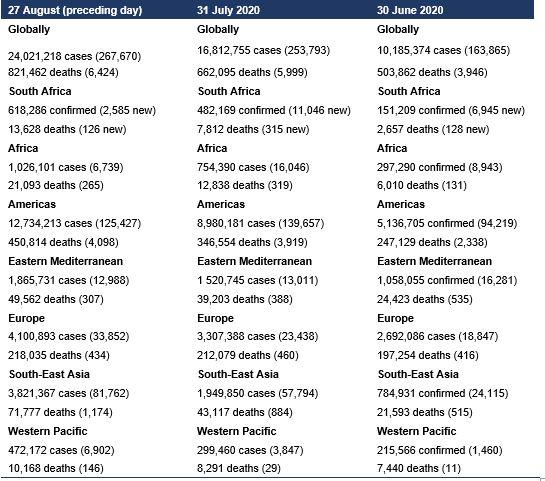
Covid-19 update
Source: WHO, NICD
Economics and markets
- Following two years of consultations, the Fed announced changes to its inflation framework.
- Fed changes, albeit slight, were unanimous and the new framework “seeks to achieve inflation that averages 2% over time”.
- Essentially, inflation overshoots will be tolerated during the period of recovery.
- Fed to lead other central banks, perhaps inspiring the ECB to adopt a similar framework.
- Decisive yet accommodative central banks will feed animal spirits, especially after a lacklustre August.
- The Fed might guide rhetoric, but it is talk of covid-19 that dominates most conversations.
- USD/ZAR opens at 17.03; EUR/ZAR at 20.14; GBP/ZAR at 22.49 and CNY/ZAR at 2.45.
A quirky play on words or perhaps an obvious take on the market after the Fed’s review of its monetary policy strategy and longer-run goals. Following two years of consultations, the Fed announced changes to its inflation framework ahead of its September sitting. The changes, albeit slight, were unanimous and the new framework “seeks to achieve inflation that averages 2% over time". As a result, "following periods when inflation has been running persistently below 2%, appropriate monetary policy will likely aim to achieve inflation moderately above 2% for some time."
Essentially, inflation overshoots will be tolerated during the period of recovery. Achieving that rate is an altogether different conversation, especially after the Fed dropped specific quantitative targets for maximum employment. Inflation would therefore need to manifest organically through the real economy or asset prices, suggesting that the Fed will allow the economy to run hot until such time as maximum employment is achieved. The outcome of the review, though not unsurprising, provokes an interesting thought. Is this the precursor to enhanced forward guidance at the September FOMC? Possibly. Though it might be specific to the course of interest rates rather than asset purchases. As is customary, the Fed will lead other central banks, perhaps inspiring the ECB to adopt a similar framework when its resumes its review of monetary policy, which was delayed on account of the pandemic.
Decisive yet accommodative central banks will feed animal spirits, especially after a lacklustre August. With the Fed factor still in play, markets are poised for another positive day. Japan is the exception as investors contemplate a world of Abenomics sans Abe, as the premier is speculated to announce his resignation due to health reasons. Like in 2007, Japanese stocks will probably underperform, tempering risk taking, though a weaker US dollar and steepening US yields should sustain EM bids until the close of play.
The rand is wavering at 17 against the greenback after triggering stop losses at 16.95 during the latter part of the New York trading session. Despite a weaker US dollar, the impetus for gains has been lost as the week draws to a close. Local news flow is uninspiring, as detailed in our local rates section, and the National Treasury’s want of higher tax revenues is causing somewhat of a stir. Global determinants remain positive, with China showing meaningful signs of recovery, spurring industrial metals prices. With EUR/USD stalling at 1.185, we expect the local unit to remain rangebound.
The Fed might guide rhetoric, but it is talk of covid-19 that dominates most conversations. It was only a matter of time before experimental treatments were trialled in South Africa. Despite a progressive decline in the rate of infections, daily cases are still elevated when compared to our African peers. The drug will be made available in SA if the outcomes of the testing on high-risk patients are successful, potentially alleviating the impact of an impending second wave. The publication of the covid-19 advisories by the Department of Health provides necessary insight into the scientific and medical research that has taken place since the onset of the pandemic. While most advisories were adopted by the covid-19 council in its entirety, the delay in publication has drawn criticism from various quarters as contributing to incoherent policy on controversial issues. Information is something we can’t be overfed with!
Nema Ramkhelawan-Bhana
Local rates
In a mixed day for bonds yesterday, we had a slight relief rally after the R2048 green-shoe option was fully taken up, but only half the R2030s and none of the R186s. The reduced take-up always gives the bond market a small amount of comfort given the size of potential extra green-shoe issuance not occurring
This slight positive sentiment quickly evaporated though as President Ramaphosa confirmed that the Ts & Cs attached to the US$2bn World Bank loan were too onerous and the offer had been declined, which immediately put supply concerns back into investor’s minds, with both the bond market and rand weakening in response to the announcement, and USD/ZAR back above 17.00 almost immediately. We feel though that given the recent large increase in domestic issuance, plus above average green-shoe take-up, the shortfall created by the loan refusal could feasibly be covered by the domestic market. Also adding some positive sentiment is of course the massive coupon flow on Monday which, at close to R30bn, will create some demand for nominal bonds, potentially at Tuesday’s weekly auction.
On the auction front, we have the weekly ILB auction this morning at 11am and, given the big positive carry months coming up in September and October, we expect strong demand today, with the shorter-dated I2025 expected to be particularly popular. Along with the I2025, we also have the longer-dated I2038 and I2046 to make up the planned R2bn issuance today.
Deon Kohlmeyer
loading form...