
GM Daily: Open sesame
Global: Markets disappointed by ambiguous Fed average inflation narrative
SA: Level 1 on the horizon
Rand: Caught between the Fed and the SARB
Local rates: To cut or not to cut, that is the question
What to watch today
- EC Construction Output (y/y)
- EC CPI (y/y)
- UK Bank of England Bank Rate
- US Philadelphia Fed Business Outlook
- US Initial Jobless Claims
- US Continuing Claims
- SA SARB Announce Interest Rate
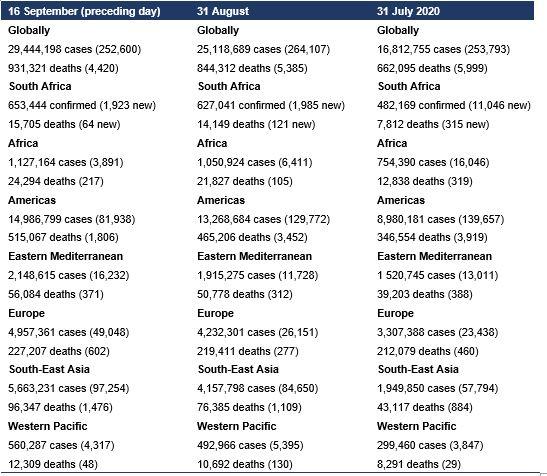
Covid-19 update
Source: WHO, NICD
Economics and markets
- It’s taken six months, but we’re now in a position to reopen our borders and relieve businesses of the regulatory burden imposed by lockdown.
- Success is relative. Much will depend on the eradication of graft and the enactment of much-needed and long-awaited reforms.
- Policy officials will need to do their part.
- The SARB will act in a complementary manner, though has already done a considerable amount of heavy lifting.
- We expect a further 25bp cut in the repo rate at today’s SARB meeting.
- By and large, the rand will be led by the US dollar, which advanced despite a fairly dovish Fed last night.
- USD/ZAR opens at 16.25; EUR/ZAR at 19.20; GBP/ZAR at 21.07 and CNY/ZAR at 2.41.
It’s taken six months, but we’re now in a position to reopen our borders and relieve businesses of the regulatory burden imposed by lockdown. Arguably, the transition to level 1 of government’s risk-adjusted strategy is long overdue given the adverse impact on critical sectors of the economy. Yet, the progressive decline in active covid-19 cases over the last six months does suggest that social distancing has had the intended health effect. Whether or not a second wave of infections is forthcoming depends very much on levels of surveillance, vigilance and constant monitoring. SA is not immune, but we are resilient.
“We have withstood the coronavirus storm. Now is the time to return our country, its people and our economy to a situation that is more normal, that more resembles the lives that we were living six months ago.” That according to President Ramaphosa. Success is relative. Much will depend on the eradication of graft and the enactment of much-needed and long-awaited reforms that have been agreed to by business, government and labour alike. Policy officials will need to do their part, with the onus falling on the National Treasury to ensure fiscal prudence, which is critical to SA’s sovereign ratings fortunes as our debt burden becomes untenable.
The SARB will act in a complementary manner though has already done a significant amount of heavy lifting in the accommodation that it has provided since March. We dedicate a considerable part of today’s commentary to explaining the rationale behind our monetary policy call of a 25bp cut to the repo rate. The view, led by our macroeconomics team, is premised on the recent 2Q20 GDP print that should push the SARB’s 2020 GDP forecast lower as it has for many a forecaster and agency, with the OECD projecting an 11.5% contraction in 2020, the most severe among the EMs. Further supporting this view are various MPC members’ comments that inflation is not a major concern.
Since the July MPC meeting, there has been a flood of data releases as StatsSA has caught up with the lockdown-related backlog. Key data such as GDP growth for the second quarter and sentiment indicators for the third quarter are now available. The SARB has emphasised its dependence on data of late, and new data available since the July MPC meeting shows that inflationary pressures remain muted and that the economy contracted more than expected in 2Q20.
Our assessment is that the SARB will keep interest rates low well into 2022. The reasoning is multi-fold: the global economic recovery will suffer some setbacks as covid-19 lingers and inflation remains very low, keeping DM interest rates, in particular, at or near zero, while QE is to remain a feature of DM monetary policy over the corresponding period. If you’re looking for odds, our team attaches a 65% probability to a 25bp cut at the September MPC meeting and a 35% probability to the SARB keeping rates on hold.
A dovish SARB implies a potential steepening of the nominal bond curve (refer to the local rates section). Its impact on the rand market is less clear. Intuitively, a cut erodes the value of the carry trade as real rates fall. However, investors look kindly on policy accommodation as it implies sustained economic support to an ailing economy. By and large, the rand will be led by the US dollar, which advanced despite a fairly dovish Fed last night. The ambiguity around the average inflation narrative has led to disappointment, which is being expressed through softer equities futures and a slight aversion towards risk.
A less than ideal situation for the rand, which has shifted lower in its current trading range. Despite the Fed’s forward guidance, its change in policy strategy is something new that the market is going to have to become accustomed to. Further debate over the Fed’s policy intentions and forecasts will probably overshadow the BoE’s meeting today. It’s as though the apex bank is being held to ransom by Brexit negotiations. The committee’s challenge is therefore to maintain policy continuity in the face of growing uncertainty.
Close sesame.
Nema Ramkhelawan-Bhana
Local rates
With very little news or data out yesterday to spur price action, SAGBs traded in a very uninspiring range for most of the day as the market awaited last night's Fed and today's MPC meeting. The National Treasury announced a duration-heavy slate of bonds for next week's auction, with the R2035, R2040 and R2048 on offer. The curve steepened somewhat on the announcement and should put pressure on any flattening for the rest of the week.
Overnight, we've had the Fed announce no further stimulus, which has resulted in the dollar strengthening against most EM currencies. Bonds have opened unchanged from yesterday's close and should trade in a narrow range until the MPC meeting. The market is relatively split as to whether the SARB will cut rates or not and we should be in for an interesting afternoon. The curve should flatten if the tone of the speech is hawkish, but the longer-dated auction next week should put breaks on how aggressive the flattening could be.
Michelle Wohlberg
loading form...