
GM Daily: Necessity is the mother of invention
Global: US supreme court vacancy vacant no more
SA: Western Cape’s focus turns to use of tech for TB screening
Rand: USD/ZAR trading around 16.20 on dollar weakness
Local rates: Auction Tuesday before MTBPS
What to watch today
- EC M3 Money Supply (y/y)
- US Durable Goods Orders
- US FHFA House Price Index (m/m)
- US Richmond Fed Manufact. Index
- GE Retail Sales NSA (y/y)
Covid-19 update
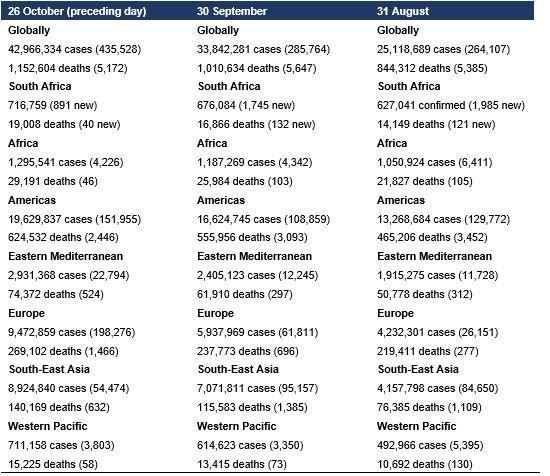
Source: WHO, NICD
Economics and markets
- Two days in a row the US has recorded new covid-19 cases at over 80,000 people, spurring US markets lower on Monday.
- A week before the US elections (for voters who have not already posted their ballots), a Republican victory comes in the form of Amy Coney Barrett’s confirmation to the Supreme Court.
- SA is in a bit of a holding pattern, at least with respect to economic news, as all the action is set to begin tomorrow.
- SA markets will be guided until then by global sentiment, with recent dollar weakness pushing the rand to trade around the 16.20 level.
- USD/ZAR opens at 16.23; EUR/ZAR at 19.16; GBP/ZAR at 21.12 and CNY/ZAR at 2.42.
Two days in a row the US has recorded new covid-19 cases at over 80,000 people – a significant spike after the recent low, on 10 September, of just over 23,000 new infections. Alongside the rising infection rates in Europe and rapidly decreasing probability of a US stimulus deal before the US elections (next week), markets have turned quite strongly negative. The Dow, S&P 500 and Nasdaq closed at the end of Monday’s trading session 2.3%, 1.9% and 1.6% lower than opening levels. The concern over the rising new infections rates is that, in the absence of a vaccine, governments are relying on increasing restrictions (short of full lockdown) to address the issue, which suggests that the global economic recovery could be slower than originally anticipated (we can even go alphabetical here and wonder if the purported v-shaped recovery will turn w-shaped, or perhaps u-shaped, depending on different economies’ stages of recovery at this point!).
Further volatility should be injected into markets as we draw ever nearer to 3 November – when those voters who have not cast their ballot early will have one last opportunity to have their say on who will lead the US for the next four years. In this respect, the Republican party, and President Trump, will be claiming a victory with the installation of Amy Coney Barret in the vacant seat of the Supreme Court. This leaves the balance of the court heavily conservative, with President Trump possibly hoping that, should he choose to contest the election, or parts of it, his case will be heard by a panel of justices he hopes will be supportive.
Across the Atlantic, the UK and EU continue intense negotiations for a trade deal with an aim to have an agreement for leaders by mid-November – the weather may be cooling down up north, but November’s event risk will keep market participants on their toes.
Domestically, SA is in a bit of a holding pattern, at least with respect to economic news, as all the action is set to begin tomorrow. However, that is not to say that nothing is happening here. SA is thankfully experiencing relatively contained rates of new covid-19 infections, although this could change rapidly. As such, domestic equity markets will probably be driven by global sentiment until tomorrow afternoon. The rand, after weakening against the dollar yesterday, has strengthened to near 16.20 to the US dollar. This is very much a sign of dollar weakness (in the wake of rising infection rates) rather than rand strength.
What has been interesting to me is that the fast and broad spread of covid-19 through the world and locally has resulted in new uses of available technology. If I am to pop to the office, even just briefly, I have a screening app and temperature recording app for work, but on a broader scale, there is the covid-19 app which makes use of Bluetooth technology to track (broadly) the movement and interaction of people (who have the app installed) so that should anyone become infected (and log it on the app), others who are at risk can be notified. There are those who I am sure will see a more nefarious intention by the government behind this. I, personally, have come to terms with the fact that given my cellular, google and social media interactions, there is not much that remains a mystery to those who wish to track me – at least in this case, rather than being used to target adverts, the app is being used to monitor my risk exposure.
In this respect, necessity is really the mother of invention, and even better, it would seem that such an approach does not have to remain limited to use for covid-19 but can be expanded to track and screen other highly infectious diseases ravaging various communities. The Western Cape, which has noted a significant drop in testing for TB recently, is looking to expand the use of cellular screening and, as a result, targeted testing for the disease. This could help to deal with a disease that was challenging SA long before covid-19, and which will remain a challenge thereafter. A sign that life after covid-19 will be different, but that there will be gains as well as losses.
Siobhan Redford
Local rates
The market is somewhat divided when it comes to a potential change in bond market issuance in tomorrow’s medium-term budget, which will definitely make for an interesting auction today. With many participants potentially taking the wait-and-see approach and staying on the side lines, it may also be a great buying opportunity, as well as seeing successful bidders rewarded with green-shoe options, which obviously run to this Thursday, and will benefit from any positive budget news. The National Treasury tried to keep the bonds on offer today on the shorter side, maturity wise, with both the R186 and R2030 on offer for the general market as well as the R2048 for the longer-term liability hedging type of clients. Today’s auction is tough to call with all the uncertainty around, but we do feel that the lure of the green-shoe optionality and the fact that the bonds on offer have generally been quite popular should see a reasonable result, with the three bonds all clearing around the prevailing mid-market levels.
After the auction, we expect the market to die down in anticipation of tomorrow’s budget, and with only US Durable Goods order data out this afternoon and a stable rand, there seems to be no reason to expect much action for the rest of the day.
Deon Kohlmeyer
loading form...