
GM Daily: Heading into the home straight
Global: Political sparring
SA: Data abundance
Rand: Without direction
Local rates: Rand under pressure
What to watch this week
Monday
- SA PPI
Tuesday
- JN Tokyo CPI (y/y)
- SA SARB Quarterly Bulletin
- UK Net Consumer Credit
- UK M4 Money Supply (y/y)
- SA South Africa Unemployment
- GE CPI (y/y)
Wednesday
- UK Lloyds Business Barometer
- JN Retail Sales (y/y)
- CH Manufacturing PMI
- GE Retail Sales NSA (y/y)
- UK GDP (y/y)
- SA Money Supply M3 (y/y)
- SA Private Sector Credit (y/y)
- GE Unemployment Change (000's)
- SA CPI
- SA Trade Balance Rand
- SA Monthly Budget Balance
- US GDP Annualized (q/q)
- US GDP Price Index
- US Pending Home Sales NSA (y/y)
Thursday
- JN Jibun Bank Japan PMI Mfg
- GE Markit/BME Germany Manufacturing PMI
- EC Markit Eurozone Manufacturing PMI
- UK Markit UK PMI Manufacturing SA
- SA Absa Manufacturing PMI
- EC PPI (y/y)
- EC Unemployment Rate
- SA Electricity Production (y/y)
- SA Electricity Consumption (y/y)
- US Initial Jobless Claims
- US Markit US Manufacturing PMI
- SA Naamsa Vehicle Sales (y/y)
Friday
- JN Monetary Base (y/y)
- EC CPI Core (y/y)
- US Change in Nonfarm Payrolls
- US Unemployment Rate
- US University of Michigan Sentiment
Covid-19 update
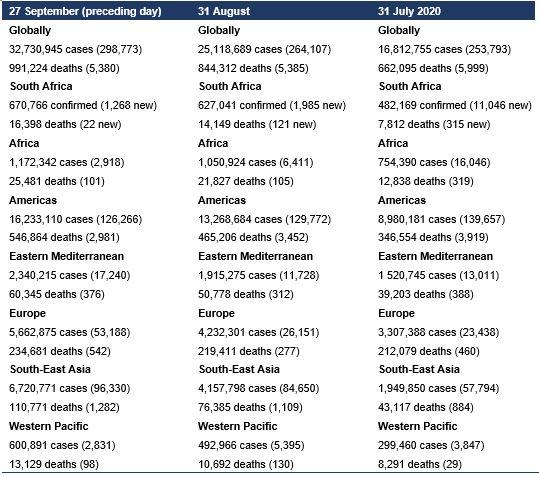
Source: WHO, NICD
Economics and markets
- This week will fill your bowls as statistical releases are plentiful.
- October brings with it heightened fiscal angst as the market readies itself for the Medium-Term Budget Policy Statement.
- For currency markets, global determinants will continue to set the pace ahead of the all-important US elections.
- Tuesday’s first presidential debate will prove as entertaining as it will instructive, especially for Asian markets.
- USD/ZAR opens at 17.02; EUR/ZAR at 19.95; GBP/ZAR at 21.82 and CNY/ZAR at 2.51.
We’re into the final stretch of what can only be described as a most bizarre year. For South Africans, Heritage Day (celebrated on 24 September) provided a welcome reminder of our cultural and societal diversity. More importantly, it provided few with a welcome reprieve from our hum drum work-from-home existence. Despite my musings, I consider it a privilege that many do not share – a common reality that should be exposed in this week’s domestic unemployment figures for 2Q20. A number potentially at its highest level on record, in line with the woeful 51% contraction in economic activity.
For those of you starved of data, this week will fill your bowls as statistical releases are plentiful. Local consumer and producer prices are usually quite important to the fixed-income market, informing real rate expectations. However, the monthly data is forecast to remain flat as economic activity is still weak, potentially diminishing its importance. October brings with it heightened fiscal angst as the market readies itself for the Medium-Term Budget Policy Statement. The NT’s macroeconomic assumptions, potential expenditure overruns amid the impasse in wage negotiations, additional SOE outlays and the resultant financing implications will have a bearing on the local curve.
For currency markets, global determinants will continue to set the pace ahead of the all-important US elections, where the senate race might prove more crucial than the presidential outcome. Indicators of market volatility remain elevated into 2021, expressing uncertainty over the actual outcomes. The Guardian’s latest poll puts Biden ahead of Trump but that doesn’t assure victory. Recall that Clinton led Trump for most of 2016. Tuesday’s first presidential debate will prove as entertaining as it will instructive, especially for Asian markets, where policy changes have been most pronounced over the last four years. The President’s ban of TikTok has been blocked, at least temporarily, following a federal judgement putting the November sale deadline on ice. An unlikely trigger for Asian outperformance but still encouraging for an already sprightly market which traded in the green this morning after further signs of continued recovery in China.
That would otherwise be positive for risk assets and ostensibly the rand, but Tuesday’s Biden-Trump showdown could potentially change the game if there is no clear winner, especially as virus case numbers in Europe are on the rise. PMI data this week will provide important context for whether the European economic recovery has the momentum to cross this hurdle. The ECB and Fed’s take on matters will prove interesting following recent policy revisions, with several officials due to speak this week. The blend of narrative, data and priced volatility doesn’t provide much immediate direction for the rand or EM assets. Resistance on USD/ZAR is now set at 17.20 as EUR/USD flounders at 1.16. Rather than price expectations, markets will await outcomes this week, implying unpredictable and potentially impulsive moves.
Par for the course, one could say.
Nema Ramkhelawan-Bhana
Local rates
The local currency is trading back to familiar territory above the 17.00 handle, down from Friday’s 17.26 high. The implied volatility of most EM currencies has followed suit, as they continue to trade at elevated levels, with the three-month at-the-money being marked around 19.45 ahead of London’s opening session. SAGBs endured a difficult week with foreign investors remaining better net sellers of the local bonds, however this theme was not only synonymous to the SAGBs as the rest of EM bonds also came under seller pressure, particularly on Friday.
The local bonds are still offering good pick-up, with a mild but persistent steepening pressure as the R2044/R186 spread is middling above 430bp this morning and ahead of tomorrow’s nominal auction where the National Treasury will come to market with R186s, R2030s and R2037s. On Friday, we had our weekly inflation auction, where I2029s, I2038s and I2046s were on offer, with the allocation relatively evenly spread. The I2029s (690m) cleared auction at 4.15 at a bid-to-cover ratio of 1.32, the I2038s (690m) cleared auction at 4.80 at a bid-to-cover ratio of 1.54, while the I2046s (620m) cleared auction at 4.84 with a bid-to-cover ratio of 1.84. The mark-to-market levels were 4.15, 4.80 and 4.85, respectively. Good luck for the rest of the week.
Tebogo Mekgwe
loading form...