
Global Markets Daily: Constant vigilance!
Global: Increased infections in the US halts economic opening in some states
SA: The peak is only beginning
Rand: Fairly priced at current levels, volatility remains
Local rates: Curve flattening on the cards
What to watch today
- JN Tokyo CPI
- US Personal Income
- US Personal Spending
- US University of Michigan Sentiment
Covid-19 update
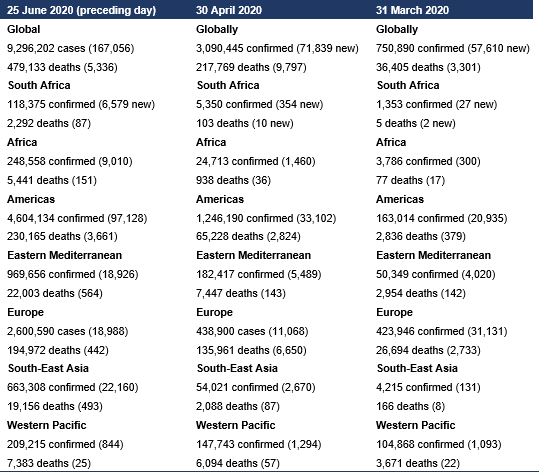
Source: WHO, NICD
Economics and markets
- The US has seen an increase in the rate of new infections, approaching its previous high levels, resulting in a halt to the economic re-opening of US states.
- Similarly, SA has experienced a steady increase in the rate of new infections as the economy has opened up, adding a further 6,579 confirmed cases to the count yesterday.
- Next week we will see 1Q20’s delayed GDP release and are expecting a contraction, which will not have been strongly covid-related.
- The JSE closed in the red yesterday, but markets are rallying today as hopes for even more economic policy support arise.
- We expect volatility to remain the name of the game for the rand – in periods of heightened uncertainty, it will weaken toward 17.50 against the US dollar, but in periods of greater optimism, could breach the 17.00 lower level more often.
- USD/ZAR opens at 17.15; EUR/ZAR at 19.24; GBP/ZAR at 21.29 and CNY/ZAR at 2.42.
The news is pretty sobering this morning, following a theme that has been building this week: the peak of covid-19 has not passed. The US, in particular, has seen an increase in the rate of new infections approaching its previous high levels. In Texas, for example, elective surgeries have been cancelled as the demand for hospital beds rises rapidly. Further, Governor Greg Abbott has declared that the economic reopening in Texas will halt for now (but not necessarily be pared back). Back home, the story is similar, as SA has experienced a steady increase in the rate of new infections as the economy opens up, adding a further 6,579 confirmed cases to the count yesterday.
The novel coronavirus (as it was first termed) has been in the news now for almost six solid months, and as repetitive as it feels writing about it, people are also feeling fatigue from hearing about it, which is perhaps resulting in a degree of complacency when out in public. It is now, when we start lowering our defenses, that we will expose our weaknesses as a society, enabling an acceleration in infection rates (and lest we forget, the thinking is that the number of asymptomatic cases is significantly higher than recorded cases, not just in SA, but globally). Thus, it is “constant vigilance” that we need to practice (the foe may be different, but Professor Moody’s trademark phrase has never been more relevant to a muggle than in 2020). The concern is not getting the virus – the chances are high, especially in the absence of a vaccine – but rather the pace of infection. If we all fall ill at the same time, we may not be able to access the medical support we need as the healthcare system falls under pressure.
Sadly, the fallout is not just limited to health and healthcare, but infuses into the economy as places of work are forced to close and people forced to self-isolate as exposure to the virus increases. This puts further pressure on economic activity, which was already weak in SA prior to the pandemic. Next week we will see 1Q20’s delayed GDP release and are expecting a contraction which will not have been strongly covid-related – that shock will only be enumerated in the 2Q20 release, which we anticipate to be even more sobering. The problem with data is that it is backward looking, next week we enter 3Q20, and to give our economy and people the best chance to ensure increased economic activity (and thus reduce the poverty effect of lockdown), we must not forget to continue social distancing.
Markets are starting to reflect a similar concern. After rallying on news of v-shaped recoveries and opening economies, these setbacks are going to reflect in continued uncertainty resulting in market volatility. The JSE closed in the red yesterday, but markets are rallying today as hopes for even more economic policy support arise. Similarly, the rand has taken a bit of a knock in the run up to the release of the Special Adjustment Budget and, despite the relatively poor news out of the NT’s update, has rallied since. We expect volatility to remain the name of the game for the rand, which will sit around current levels, weakening toward 17.50 against the US dollar in periods of heightened uncertainty, but in periods of greater optimism potentially breaching the 17.00 lower level more often.
Covid-19 has definitely defined a new normal for the world, but normal is not how we must treat it in our daily lives – it remains an invisible foe, not only to people’s health, but also their livelihoods. As a nation, and as a global population, it is upon us to not become complacent, not just for ourselves, but for our fellow man. Thus, on this sobering note, have a good weekend, but stay safe.
Siobhan Redford
Local rates
With the budget out of the way, SAGBs opened somewhat weaker on Thursday morning as investors crystallised profits of their in-the-money non-comp options. After non-comp options had been taken up, the bonds traded well and yields managed to move lower, with the back end of the curve flattening aggressively. We should continue to see further flattening of the yield curve as the National Treasury continues to issue shorter-dated bonds.
The National Treasury comes to market today issuing I2025s,I2038s and I2050s. Flow in the secondary market has been somewhat muted as investors focused on the budget and CPI prints. That being said, we continue seeing constructive demand in ILBs and expect today’s auction to be well supported with all three bonds anticipated to clear at, or slightly weaker than, current mark-to-market levels.
Michelle Wohlberg
loading form...