
GM Daily: Fear or folly
Global: Apparent improvement in Trump’s health allays market concerns
SA: NCR reveals high rejection rates during lockdown
Rand: Consolidation is the name of the game
Local rates: Foreign selling eases, or does it?
What to watch today
- GE Factory Orders WDA (y/y)
- GE Markit Germany Construction PMI
- UK Markit/CIPS UK Construction PMI
- US Trade Balance
- US JOLTS Job Openings
Covid-19 update
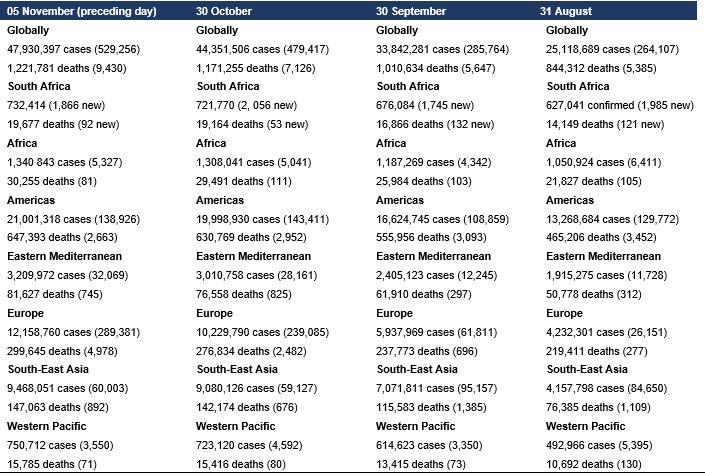
Source: WHO, NICD
Economics and markets
- Concerns over Trump’s wellbeing have been allayed by his controversial return to the oval office.
- The outcome of the election is almost irrelevant as markets are pricing a rising probability of Biden winning.
- Potential policy changes are of great concern to a market that has been roiled by trade, tech and twitter wars for the last four years.
- Global bourses are trading in the green with Asian and European benchmarks matching or bettering the US’s overnight performance.
- Rand consolidates below USD/ZAR16.50, trailing other EM currencies.
- USD/ZAR opens at 16.58; EUR/ZAR at 19.54; GBP/ZAR at 21.52 and CNY/ZAR at 2.43.
One million deaths, more than 35 million people infected worldwide and yet the leader of the free world, Donald J Trump, has urged citizens to not let covid-19 rule their lives. A show of strength? Or perhaps a display of ignorance as to the severity of a virus which has ravaged the globe for the last eight months.
Concerns over Trump’s wellbeing have been allayed by his controversial return to the oval office. In true Trump twitter style, a flurry of entertaining one-line capitalised tweets in the final hours of voter registration in the southern belt of the US convinced the market of his apparent improvement. Whether he is fit to return to the campaign trail is a matter for his medical team. The outcome of the election is almost irrelevant as markets are pricing a rising probability of Biden winning, with a steepening yield curve and weakening US dollar reflecting the change in odds. If the polls are to be believed, then Biden could win the presidential seat even if the Democrats lose the perennial swing states.
Why then do measures of volatility remain elevated post the elections? Potential policy changes are of great concern to a market that has been roiled by trade, tech and twitter wars for the last four years. A democratic sweep of the congress comes with its own set of fears as Biden advocates for higher corporate taxes among other contentious reforms. However, some degree of predictability should steady the ship as we navigate a new year. For now, investors are fixated on maintaining stability. A leadership void in Washington would upend trade, especially as a house committee looks to propose sweeping reforms of the technology sector. Despite there being several procedural tools to block the bill from passing, the mere mention of reforms has dimmed the tech-heavy Nasdaq’s performance.
On the whole, global bourses are trading in the green, with Asian and European benchmarks matching or bettering the US’s overnight performance, spurring risk assets. US dollar weakness, albeit slight, has reinforced EM currency gains. The rand is an obvious exception as it bumbles along in the 16.50s against the greenback, reflecting some degree of consolidation after days of sustained strength. We could attribute the stalling momentum to local happenings.
The National Credit Regulator’s findings that declining credit applications during the lockdown were accompanied by the highest rejection rate since records began is alarming, as it suggests that people applying for credit might have been doing so out of desperation. Further evidence of SA’s demand woes, though it shouldn’t be an unsettling factor for the rand market, which is rather impervious to domestic data. The situation does underscore the need for urgent reform, a sentiment reiterated by President Ramaphosa at the closing of the ANC lekgotla. Timing though, remains elusive.
Nema Ramkhelawan-Bhana
Local rates
A long-running theme in the local bond market has been the reduction in offshore holdings of our government debt this year. According to Strate, their overall holdings of government bonds have gone from around 37% at the end of 2019 to a touch above 29% at the end of September.
More worryingly, given the big surge in nominal issuance this year, their holdings in nominal bonds have dropped from R800bn to R725bn over the same period. This has meant that local banks and investors have not only had to take up the slack of the increase in outstanding government debt, which has risen from R1,800bn to R2,086bn this year, but also absorb the R75bn offshore counterparties have sold this year.
Yesterday saw a turnaround of sorts, with data showing offshore investors were net buyers of around R500m but again closer inspection reveals that although they were buyers of R1bn R2023s and R300m R186s, they were net sellers of basically all the longer-dated bonds, which would indicate that in terms of relative risk they were actually flat or slightly reducing exposure to SA Inc again.
This would all point to another interesting auction this morning with the National Treasury offering R2.2bn of each of the relatively short R2030 and ultra-long R2040 and R2048s. Local investors have been supportive of the longer R2048 specifically, so hopefully the auction will clear relatively well today with the slightly stronger rand and a more helpful global risk environment.
No real economic data of note today, but look out for the SARB Monetary Policy Review due for release this afternoon at 16:30.
Deon Kohlmeyer
loading form...