
GM Daily: Fear not, for level 1 is nigh
Global: Brexit fatigue
SA: A transition towards level 1 is imminent according to the health minister
Rand: Rangebound
Local rates: Curve steepens with issuance fears
What to watch today
- UK RICS House Price Balance
- SA Current Account Balance
- SA Mining Production
- SA Manufacturing Production
- EC ECB Main Refinancing Rate
- US PPI Final Demand (y/y)
- US Initial Jobless Claims
- US Continuing Claims
- CH Money Supply M2 (y/y)
Covid-19 update
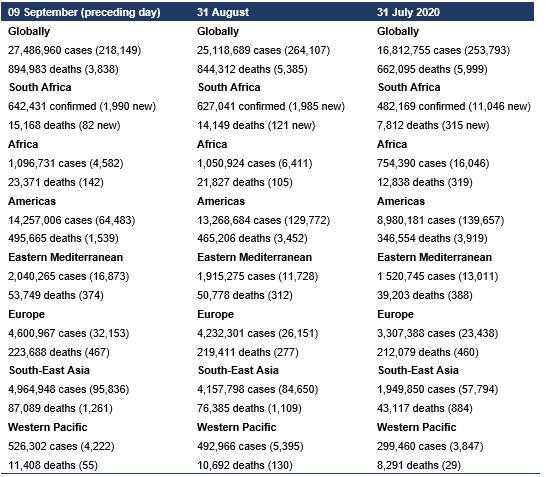
Source: WHO, NICD
Economics and markets
- Encouraged by the country’s decreasing rate of covid-19 cases, minister Mkhize has hinted at a transition to level 1 in coming days.
- Although heartening, we should not be misled by the recovery in 3Q20 business confidence.
- Transparent and expeditious policy enactment is crucial to confidence.
- The latest round of Brexit negotiations in the world’s longest divorce settlement is scheduled to conclude today without resolve.
- The Bloomberg Brexit Barometer/Bliss Index, which tracks economic wellbeing/health in the UK, is at its lowest level in almost nine years.
- Brexit might be mentioned in jest by Governor Lagarde as she takes to the stage this afternoon to deliver the ECB’s latest policy assessment.
- USD/ZAR opens at 16.60; EUR/ZAR at 19.60; GBP/ZAR at 21.59 and CNY/ZAR at 2.43
Fear not, for level 1 is nigh. This according to SA’s health minister. Encouraged by the country’s decreasing rate of covid-19 cases, minister Mkhize has hinted at a transition to level 1 in coming days. A welcome and necessary shift for an economy in grave distress – a reality that should once again be evident in high-frequency mining and manufacturing data for July, though the outcomes of today’s data prints should show slight improvements at the beginning of the third quarter.
Although heartening, we should not be misled by the recovery in 3Q20 business confidence. Our economists stress that the index paints an improved picture relative to 2Q20, but it is important to realise that the confidence has risen more than underlying activity. This would be a signal that there will probably be significant lags between the improvement in confidence and a return to pre-covid levels of activity. Transparent and expeditious policy enactment is crucial to confidence. President Ramaphosa must take the lead in this regard but believes that history will absolve him. “The system has been so weakened that we have come from the incapacity of a war zone. But we are painstakingly putting things right and we have now reached a stage where the change we have all wanted to see will start unfolding,”
Speaking of unfolding, or rather unravelling, the Brexit saga is never ending. The latest round of negotiations in the world’s longest divorce settlement is scheduled to conclude today without resolve. The plaintiff (UK) and defendant (EU) continue to squabble over access to UK waters and state aid. Johnson’s breach of substantive provisions of last year’s agreement to allow companies in Northern Ireland “unfettered access” to the UK. The contravention of approved terms under the UK Internal Market Bill, ratified on Wednesday, is the latest challenge to the EU’s proposed conditions. A breach of these obligations could result in financial sanctions if the EU seeks a legal remedy under the withdrawal agreement.
Trade barriers are as probable. This would be debilitating for UK manufacturers who are already buckling under the pressure of covid-19 and readily transact with neighbouring European countries. The Bloomberg Brexit Barometer/Bliss Index, which tracks economic wellbeing/health in the UK, is at its lowest level in almost nine years. The Brexit fatigue is reflected in pound options rather than the spot price, as the cost of puts has climbed amid fears that the 15 October deadline will be missed. An apparent second wave of covid-19 cases casts further doubt on whether the economy can withstand further political pressures.
Brexit might be mentioned in jest by Governor Lagarde as she takes to the stage this afternoon to deliver the ECB’s latest policy assessment. The optimism expressed in July is at risk of being deflated by the rising trend of covid-19 cases across the bloc, which poses downside risks to economic prospects, especially in hotbeds such as Spain and France which could re-enact restrictive measures. Staff GDP estimates will clarify the Bank’s growth view, while its inflation forecasts will tell whether it perceives deflation to be persistent and long-lasting.
The outcomes are unlikely to warrant additional stimulus at this stage. As the committee expressed in July: the “flow of information over the summer…and… the scale of the initial bounce back in activity was not necessarily a good guide to the speed and robustness of the recovery”. If, however, downside risks begin to manifest, then further policy stimulus is warranted. EUR/USD’s exploits above 1.18 might be cut short if the market is disappointed by Lagard’s address, which would curtail the rand’s recent gains.
Having reverted to pre-GDP levels, the rand is leading the EM pack. A common occurrence it seems, though the impetus for further gains is lacking, especially as global determinants peter out. Range trading is the order of the day with support evident at 16.55 against the greenback.
It’s all about levels today.
Nema Ramkhelawan-Bhana
Local rates
With this week’s auction not really well supported by local clients, the market has become concerned that issues such as ongoing and potentially increasing SOC support, as well as the growing problem that is the state of municipalities, may force the Treasury to look at increasing weekly issuance instead of the reduction, in at least the size of the green-shoe options, that the long-end of the market needs to recover to any degree. Case in point today is the fact that the R186 options from Tuesday are comfortably in the money, whereas the R2030 and R2035 are way out as the curve has steepened since Tuesday. The rebound in the rand overnight will help overall sentiment, but our dire fiscal situation may just lead to further bull steepening of the curve.
On the subject of the rand, watch for local 2Q20 current account data out this morning at 11:00, with a surplus of R3bn expected by us but a wide range of estimates between -R42bn and +R100bn, which shows the potential volatility around these numbers.
Also out today is SA Mining and Manufacturing data for July, which will show contractions but hopefully not as badly as in June. We also have US PPI out this afternoon at 14:30.
Deon Kohlmeyer
loading form...