Global: ECB expands PEPP by more than anticipated, lifting euro assets
SA: SARB remains active in the secondary bond market
Rand: Testing the USD/ZAR16.85 bounds but should remain rangebound ahead of US NFP data
Local rates: Risk-on rally stalling
What to watch today
- UK GfK Consumer Confidence
- JN Household Spending (y/y)
- SA Gross Reserves
- SA Net Reserves
- US Change in Nonfarm Payrolls
- US Unemployment Rate
- US Labor Force Participation Rate
- US Consumer Credit
- SA SACCI Business Confidence
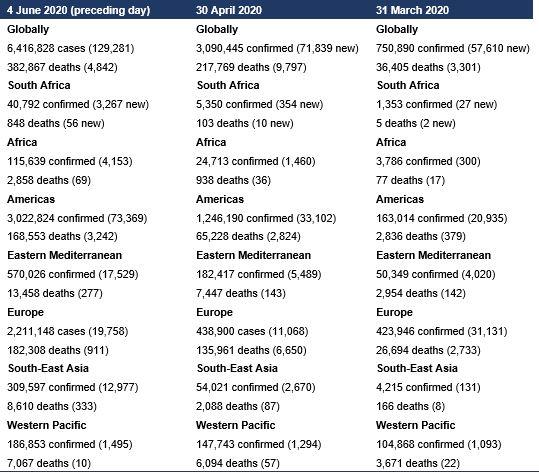
Covid-19 update
Source: WHO, NICD
Economics and markets
- It’s been called a double act by Europe’s leading ladies, as the ECB’s chair, Christine Lagarde, expanded the Bank’s emergency bond buying programme by €600bn.
- The near 2.3% appreciation in EUR/USD over the last five days is instructive for EM currencies with which it has a strong positive correlation.
- As is customary, the first week of the month holds significant event risk as the US labour report usually punctuates sentiment.
- The extension of production cuts and a cohesive OPEC+ grouping are required to ensure that the rebound in the spot price holds.
- USD/ZAR opens at 16.91; EUR/ZAR at 19.17; GBP/ZAR at 21.29 and CNY/ZAR at 2.38.
It’s been called a double act by Europe’s leading ladies, as the ECB’s chair, Christine Lagarde, expanded the Bank’s emergency bond buying programme by €600bn, to a whopping €1.35trn, less than 12 hours after Angela Merkel announced a comprehensive stimulus package for Germany. Together, the pair have moved a politically divisive union towards a collective purpose of turning around the region’s economic fortunes.
The bold and expeditious response has been lauded by investors as it contrasts the indecisiveness that was seen in the aftermath of the GFC and the European debt crisis. The drop in 10-yr Italian bond yields, commonly viewed as a gauge of perceived risk, and the narrowing of its spread over the comparative German bond, suggests that markets are optimistic that consensus over a European recovery fund can be agreed upon.
The near 2.3% appreciation in EUR/USD over the last five days is instructive for EM currencies with which it has a strong positive correlation. The rand has certainly benefited from the risk-on rally. Having broken the 100-day moving average level of USD/ZAR16.85, the rand continues to test key support levels, nearing our terminal year-end rate of 16.50.
Volumes in the local rand market remain thin, with changes in the US dollar piloting the EM currency complex ahead of the infamous US non-farm payrolls report. A continued upturn in commodities prices, a primary input into our fair value model, remains supportive of the rand. If the rally in prices is sustained, it could have a significant bearing on our USD/ZAR estimate for the year end. Much depends on whether China’s infrastructure programme spurs reliable resources demand. Rising US-Sino tensions could stall the potential appreciation in commodity currencies, though the nature of the dispute is arguably less important to global trade than in 2018/19.
As is customary, the first week of the month holds significant event risk as the US labour report usually punctuates sentiment. The unemployment rate is expected to have soared to 19.5% in May, its highest level since 1930! And yet, this is unlikely to displace confidence in a nascent US recovery as investors continue to hold out for further stimulus. The White House is reportedly mulling over a US$1trn stimulus bill to complement the unprecedented support that the Fed has offered. A diversification away from US equities is beginning to take hold as investors poured a record US$15.6bn into US credit funds in the week ended 3 June, emphasising the importance of policy support rather than real economic data to sentiment.
The 10.2% month-on-month increase in the SARB’s net government purchases, reported this morning, is case in point. Much of the change is attributed to valuation changes rather than actual buying, but the Bank’s mere presence in the secondary market provides a strong sense of comfort to market participants, despite the wall of poor SA economic data.
I’ve left the happenings in the oil market to last as South African consumers are still displeased about the R1.18 increase in fuel prices this month. The long and short of it is that the extension of production cuts and a cohesive OPEC+ grouping are required to ensure that the rebound in the spot price holds. This seems a little tenuous as dissenters such as Iraq could derail the apparent ‘harmony’ within the alliance.
But that, folks, is a tale for another week.
Nema Ramkhelawan-Bhana
Local rates
Bonds opened up initially better bid as a strong currency supported SAGBs, but this quickly stalled once the R6.1 yards of non-comp options were absorbed by the market. Bond yields closed the day higher and the yield curve flattened somewhat, with the R186s giving up most of its recent gains.
There seems to be a bit of doubt in the current risk-on rally and it feels like the market has done a little too much too quickly. This should result in SAGBs trading in a narrow range today as the market struggles for direction. The National Treasury will come to market today, issuing R1.4bn in I2029s, I2038s and I2050s.
Fundamentally, real yields seem to be providing support at current levels. There is circa R4bn worth of coupons to be received on 8 June and this should provide support for the ILB market over the next while. While the I2029 is the least favoured bond, it was last issued on 20 March, and recent secondary market demand will probably provide bidding interest in the stock. The I2038s and I2050s have both seen general demand over the week and should have buying interest. As such, we expect bidding interest to remain at volumes seen last week, clearing at or slightly stronger than current mark-to-market levels.
Michelle Wohlberg
loading form...