
GM Daily: Consternation
Global: Common themes provoke consternation
SA: Poised for MTBPS
Rand: Steady as she goes ahead of a data-packed week
Local rates: Budget week has finally arrived
What to watch this week
Monday
- JN PPI Services (y/y)
- GE IFO Expectations
- US Dallas Fed Manf. Activity
Tuesday
- EC M3 Money Supply (y/y)
- US Durable Goods Orders
- US FHFA House Price Index (m/m)
- US Richmond Fed Manufact. Index
- GE Retail Sales NSA (y/y)
Wednesday
- UK BRC Shop Price Index (y/y)
- SA CPI (y/y)
- SA CPI (m/m)
- SA CPI Core (y/y)
- SA CPI Core (m/m)
- US MBA Mortgage Applications
Thursday
- JN Retail Sales (y/y)
- JN Consumer Confidence Index
- SA Money Supply M3 (y/y)
- SA Private Sector Credit (y/y)
- GE Unemployment Change (000's)
- SA PPI (y/y)
- SA PPI (m/m)
- UK M4 Money Supply (y/y)
- EC Economic Confidence
- US Initial Jobless Claims
- US Continuing Claims
- US GDP Annualized (q/q)
- US Personal Consumption
- US GDP Price Index
- US Core PCE (q/q)
- GE CPI (y/y)
Friday
- JN Tokyo CPI (y/y)
- UK Lloyds Business Barometer
- GE GDP SA (q/q)
- EC Unemployment Rate
- EC GDP SA (q/q)
- EC CPI (m/m)
- SA Trade Balance Rand
- SA Monthly Budget Balance
- US Personal Income
- US Personal Spending
- US MNI Chicago PMI
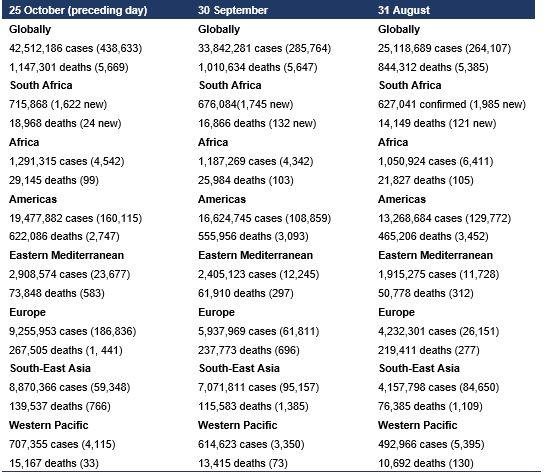
Covid-19 update
Source: WHO, NICD
Economics and markets
- Consternation – a most fitting description of market positioning ahead of key risk events.
- Two viable MTBPS outcomes: either light on detail or longer debt stabilisation plan.
- Book-ending the MTPBS will be a flurry of local data releases including CPI and PPI.
- High and rising unemployment isn’t unique to South Africa.
- Europe is struggling amid rising infection rates.
- Brexit talks extended to mid-week.
- EM assets are trailblazing.
- Clarity on China’s next five-year plan could provide a boost at the end of the week.
- USD/ZAR opens at 16.21; EUR/ZAR at 19.22; GBP/ZAR at 21.15 and CNY/ZAR at 2.43.
Consternation – a most fitting description of market positioning ahead of the mini-budget on Wednesday and highly-contested US elections on 3 November amid a surge in early voting. We’ve discussed these topics ad nauseum but cannot discount their importance despite our fatigue.
Our macro and FI team have gone to great lengths to construct viable MTBPS scenarios. Based on their extensive analysis, we expect one of two outcomes from the MTBPS: either (1) it will be light on details and continue to emphasise the SAB fiscal consolidation targets and plans to stabilise debt over a five-year period; or (2) the minister will present a plan that shows debt steadying over a longer period (possibly ten years), with realistic forecasts and feasible consolidation targets. The main budget deficit is projected to widen to 15.0% in FY20/21. The deficits could be even wider should expenditure for SOE support increase. However, we’ve assumed that any additional SOE support will come from further reprioritisation of baseline budgets as an increase in expenditure would be inconsistent with the NT’s fiscal consolidation narrative.
Book-ending the MTPBS will be a flurry of local data releases, including the CPI and PPI for September. Our macro team expects CPI to decrease to 2.9% y/y, falling below the lower end of the inflation target for the second time this year. PPI will probably increase a tad as we expect a print of 2.5% y/y, suggesting prices remained contained at both the producer and consumer levels during September.
Other data releases include the normal month-end publications such as private sector credit extension, the trade balance and monthly budget balance for September. The Quarterly Labour Force Survey for 3Q20, which was scheduled for release on Tuesday, has been postponed as Stats SA allows for more time to collect additional data and make necessary adjustments. Without seeing the data, the anecdotal evidence suggests high and sustained unemployment – a bare-faced reality when driving in and around densely populated urban areas.
High and rising unemployment isn’t unique to South Africa. The numbers aren’t directly comparable, but levels of joblessness are skyrocketing in Europe as governments reimpose restrictive measures to suppress the resurgence in covid-19 cases. In the absence of a vaccine, the swelling in active cases is alarming, eliciting strong responses. Spain has declared a state of emergency and launched a national curfew, while Italy has implemented the tightest curbs since May.
The expiration of wage support programmes paired with a growing number of layoffs in the tourism, travel and leisure industries spell trouble for the euro-area if real activity stalls. Britain faces a similar quandary, made worse by a possible no-deal Brexit. Fishing rights could scupper a deal if France and Spain are not satisfied by the terms. The UK, though, seems optimistic as talks are extended into mid-week. Three-month implied EUR/GBP volatility has subsided from its September highs but is still well above the 200-day moving average, suggesting a fair bit of angst.
Despite the whirlwind of risk, EM assets are trailblazing. Implied volatility on currencies is at its lowest in four months, while US dollar bond spreads have narrowed considerably since February. The rand has been at the forefront of this positive trend. The strength in the spot rand has pulled down near-dated implied vols against the greenback. A situation which could be tested depending on the outcome of the MTBPS.
We’d anticipated a risk rebound as the global economy began to recover but are wary of a post-election backlash, particularly if the result is contested and the House is once again split. Caution will probably prevail in the next week at least. Clarity on China’s next five-year plan, following a four-day plenum, could provide a necessary distraction from the US electioneering and stimulus banter at the end of the week, especially if authorities announce an expansion to its domestic financial markets, more proactive policy support and measures to enhance its supply chain.
Nema Ramkhelawan-Bhana
Local rates
As we head into budget week, investors are getting their ducks in a row and positioning their portfolios accordingly. We’ve seen the SAGB yield curve flatten considerably as both real and fast-money investors were seen extending duration in their portfolios last week. This does suggest that perhaps there might be some positivity building with regards to the upcoming budget, and perhaps the NT will reduce issuance resulting in further curve flattening and a bond rally. Trading SAGBs this week will most likely be a dull affair as we await further guidance from the budget.
The inflation auction on Friday was lacklustre, with very little bidding interest seen. The National Treasury issued I2025s, I2033s and I2046s. Yields cleared slightly higher than MTM levels and bid-to-cover ratios were all under 1.5. This resulted in ILBs losing further ground on Friday afternoon as investors sell out of their inflation-linked positions now that the positive carry benefit is no longer as attractive.
Michelle Wohlberg
loading form...