
GM Daily: “Common” sense
Global: Vaccine diplomacy
SA: Pricing strategies changing to meet pandemic constraints
Rand: Holding pattern continues
Local rates: Strong nominal auction
What to watch today
- UK CPI (y/y)
- UK Retail Price Index
- UK PPI Input NSA (y/y)
- UK Public Finances (PSNCR)
- UK Central Government NCR
- UK Public Sector Net Borrowing
- UK House Price Index (y/y)
- US MBA Mortgage Applications
Covid-19 update
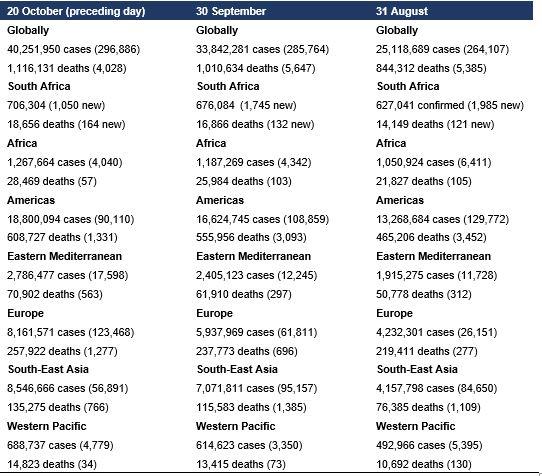
Source: WHO, NICD
Economics and markets
- A sobering number in our covid-19 update table above is that the global infection count has now surpassed 40 million people, equivalent to about two-thirds of SA’s population.
- China is taking advantage of the US’ insular approach to procurement of a vaccine by implementing “vaccine diplomacy”, suggesting that it will help with the distribution of covid-19 vaccines to a number of emerging markets.
- The Tuesday deadline for a US stimulus deal has passed, and yet it would seem that talks continue, which has buoyed markets, with US equity markets closing higher on Tuesday and Asian markets mostly up on Wednesday.
- We see the rand remaining in its current holding pattern, dropping towards 16.40 to the US dollar before moving back up.
- News that one medical aid will freeze premiums until the middle of 2021 and restrict the increase to within the inflation target, if a sign of behaviour across the insurance sector, will be good for the SARB’s inflation target.
- USD/ZAR opens at 16.48; EUR/ZAR at 19.48; GBP/ZAR at 21.33 and CNY/ZAR at 2.47.
“Common” sense is seldom that, which is why Prime Minister Boris Johnson’s preference to be rule-light in favour of relying on British common sense is proving unsuccessful in containing the renewed spread of covid-19 across the UK. As a result, he has been forced to implement stricter measures to enforce social distancing. In an attempt to avoid national lockdown, though, he has different restriction levels being implemented in different districts according to the severity of the spread of the virus. This has itself been controversial, but it is clear that common sense did not lead to appropriate social distancing, and a full lockdown would deliver a crippling blow to an economy which has already posted record rates of contraction in the post-war era.
Reading about the UK PM’s reliance on common sense brought back to me a recent conversation I had which suggested that there are areas in SA in which common sense is not being displayed either. Fellow South Africans are understandably showing signs of “covid fatigue” and thus seem reluctant to continue to social distance and wear masks, which some have done to support their president. However – and this is where not only the domestic but also the global population really hasn’t quite grasped the reality – the implementation of these measures is not to support politicians, but rather recommended, required and reinforced to help ourselves both for health and economic purposes. A sobering number in our covid-19 update table above is that the global infection count, according to the WHO, has now surpassed 40 million people. For some domestic perspective, that number is equivalent to about two-thirds of the SA population. So while we have been asked to throw our normal way of life out of the window and do a complete 180 in behaviour, there is a good reason, as in the absence of self-restraint, the government will be forced to impose rules which no doubt would push our already shocked economy into an even deeper contraction.
On the virus front, it would seem that China is taking advantage of the US’ insular approach to procurement of a vaccine by implementing what has been termed “vaccine diplomacy”, suggesting that it will help with the distribution of covid-19 vaccines to a number of emerging markets. It has been a concern for me that when a vaccine, or many vaccines, become available to the market, richer countries – and those with some level of influence over vaccine producers – will scramble to secure supply for their own populations and poorer and less influential countries will be forced to wait at the back of the queue, suggesting that covid-19 would remain a threat for an extended period in these countries. Thus Chinese vaccine diplomacy would not only help bring the vaccine to these markets earlier, but would probably increase its sphere of influence. China is also aware that for such a campaign to be successful, its vaccine offering must be effective and meet the highest healthcare standards.
The Tuesday deadline for a US stimulus deal has passed, and yet it would seem that talks continue, which has buoyed markets, with US equity markets closing higher on Tuesday and followed by gains in US futures this morning. Asian markets have traded largely higher today, although there has been some moderation in the Chinese market. As suggested yesterday, markets are all waiting for announcements and the passing of risk events (such as the US presidential election). As such, we see the rand remaining in its current holding pattern, dropping towards 16.40 to the US dollar before moving back up. Global markets will move on an announcement of a US stimulus deal, although I must confess I am now growing sceptical that this will be passed before the 3 November presidential elections – not so much due to slow progress on talks (although this is certainly a contributing factor), but also as there seems to be reluctance from GOP senators to support a stimulus bill as big as has been discussed, and moreover, reluctance to do so before the elections. Across the Atlantic, it seems that Brexit trade talks remain stalled.
It remains quiet on the home front, but I found it quite interesting that there was a rush of news about prices. SA’s cold winter appears to have impacted Limpopo’s potato harvest, which has pushed the popular root’s price up quite substantially. Hopefully this will abate as summer seems to have arrived with a bang (the heatwave in Johannesburg has been hot, hot, hot!). In other news, it appears that Woolworths is looking to reduce margins on a number of its food items, including chicken, in response to the broad impact of covid-19 on the SA consumer base. Adding to the news flow, I also received an email from my medical aid, announcing that my premiums will be the same until mid-2021, and that the increase thereafter will be capped to within the inflation target. Should this be a sign of behaviour across the insurance sector, it further reflects the broad impact of the pandemic on SA’s economy and is good news for the SARB’s inflation target – perhaps a sign that corporate SA is showing some of its own common sense.
May this common sense trump covid-19 fatigue across SA so that we can avoid the sharp rise in infection rates seen in other countries.
Siobhan Redford
Local rates
The local currency has struggled to test any meaningful levels in recent trading sessions as it continues to trade in tight ranges, and we open this morning below the 16.50 handle as other emerging market currencies show mild gains against the US dollar. The nominal auction was well-attended yesterday, with decent interest from local and offshore investors. The auction cleared strong across all the bonds on offer. The R186s cleared auction at 6.95 (market 6.95) with a bid-to-cover ratio of 3.19, the R2032s cleared auction at 10.29 (market 10.32) with a bid-to-cover ratio of 2.98, while the R2040s cleared auction at 11.59 (market 11.60) with a bid-to-cover ratio of 2.23. Yesterday ended an impressive run of bond inflows into emerging markets, but month-to-date flows suggest a risk-on environment leading up to the US elections. Despite the strong auction yesterday, intra-day flows remain supressed, with local fast money accounts selling R186s in decent size. Global equities are battling to manoeuvre in the current landscape and this theme is more evident in the EMEA equities space. Activity on the interest rates derivatives desk is steadily increasing, with the swap curve seeing payers and receivers out to 20-yr, the front end of the FRA is attracting greater than usual paying interest from local real and fast money accounts. The FRA curve still pricing in another 25bp cut by the end of the year. Good luck out there.
Tebogo Mekgwe
loading form...