RMB/BER Business Confidence Index results 19Q1: A broad-based weakening in activity pushes confidence down to worrying lows
The RMB/BER Business Confidence Index (BCI) declined by a further three points to 28 in the first quarter of 2019. This is the lowest level since the 27 index points recorded in the second quarter of 2017, and before that, the deep recession of 2009.
Figure 1: RMB/BER Business Confidence
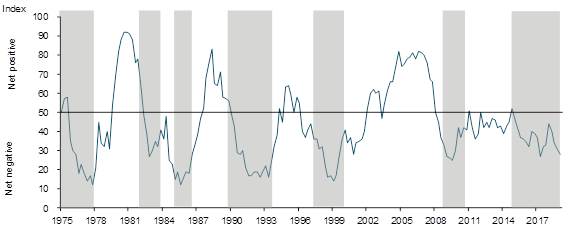
Source: BER, SARB (Shaded areas represent economic downswings)
The BCI reflects the results of a survey of 1 700 business people. The bulk of the responses were received between 13 February and 4 March 2019. The headline index reflects the percentage of respondents rating prevailing business conditions as satisfactory. The latest reading of 28, therefore, means more than seven out of ten business people were unsatisfied with current conditions.
Details
Relative to the fourth quarter, sentiment deteriorated in four of the five sectors covered by the RMB/BER BCI. The nine-point declines in the building and retail trade sectors were the largest.
- Building confidence dropped from 32 to 23, the lowest level in eight years. This fall can primarily be attributed to an across-the-board dearth of new work.
- After rallying from 23 to 33 in the fourth quarter, retail confidence reset to 24 in the first quarter. These readings are the lowest levels since the onset of the present business cycle downswing in December 2013. The low confidence stems mainly from the persistent underperformance of the largest component, non-durable goods (mainly food and beverages). Similar to 2018, the surprisingly strong performance of furniture sales remained the only bright spark.
- Although wholesale confidence declined by a relatively modest four points from 44 to 40, this conceals a massive deterioration in sales.
- After hovering around 34 in the first half of 2018, manufacturing confidence slumped to 26 in the third quarter before recovering to 30 in the fourth quarter. It relapsed to 25 in the first quarter, as an abrupt drop in export sales hit manufacturers on top of a faster deterioration in domestic sales.
- The new vehicle trade is the only sector that registered an improvement in confidence. Following the drop from 37 to 15 in the fourth quarter, motor confidence rebounded partially to a still low 26. Car sales remained dismal.
Striking in the first quarter results is how broad-based the weakness in activity has become. Four of the five sectors covered in the survey now have confidence levels in the low 20’s, with wholesalers the “least downbeat” at 40. Owing to the weakness in domestic demand, businesses’ ability to pass on higher costs has become even more constrained. The resultant further erosion of profit margins is the principal immediate reason for the first quarter’s deterioration in sentiment.
On top of this, several other external developments have suppressed the business mood. Among these were the disruptive effects of load shedding in February, prolonged labour strikes in certain sectors of the economy, slowing growth in South Africa’s main trading partners (i.e. the EU, China and the Broader Africa), more revelations about the extent of state capture and corruption in South Africa, the continued conflicting pronouncements on policies and priorities due to the contestation within the ANC and the demands of the upcoming election, as well as the adverse impact of the “expropriation without compensation” discourse on many investors’ private property security perceptions.
Bottom line
Since taking over the reins, President Ramaphosa has launched several initiatives to help reverse South Africa’s decline. Yet, as encouraging (and necessary) as these have been, measures such as these to first expose past corruption, and then to deal with rebuilding institutions, will only bear fruit in the longer term. Equally, initiatives emanating from last year’s investment and job summits will take time to deliver the desired outcomes of increased private sector fixed investment and employment creation.
But, more than this is necessary to get South Africa out of its low-growth bind. Indeed, forceful - and in some instances unpopular - structural reforms must also form part of the mix. Moreover, to secure buy-in and spread such reforms’ adjustment costs fairly, trade-offs will have to be negotiated between the government and organised labour on the one hand, and business and civil society on the other. This will demand adept political leadership, something Mr Ramaphosa demonstrated in the run-up to the 1994 political settlement.
“South Africa will not be able to shift to a lasting higher growth and prosperity path without more short-term pain”, says Ettienne le Roux, chief economist at RMB. This time around, the country cannot rely on the global economy to counterbalance such internal adjustment costs, as global growth itself is now shifting to a lower gear.
loading form...