
Global Markets Daily: Brace yourself
Global: Increasing covid-19 infection rates threaten hoped-for V-shaped economic recovery
SA: A data-intense week ahead of us, with 1Q20 GDP to be the most closely watched
Rand: The rand will most likely show bias for weakness, trading between 17.20 and 17.50 against the greenback
Local rates: Increased issuance to weigh on bonds
What to watch this week
Monday
- SA SARB Annual Report
- UK Consumer Credit
- GE CPI
Tuesday
- UK Lloyds Business Barometer
- SA Leading Indicator
- CH Manufacturing PMI
- UK GDP
- UK Current Account Balance
- SA Private Sector Credit
- EC CPI Core
- SA GDP
- SA Trade Balance
- SA Monthly Budget Balance
Wednesday
- JN Tankan Large Manufacturing Index
- GE Markit/BME Germany Manufacturing PMI
- EC Markit Eurozone Manufacturing PMI
- UK Markit UK PMI Manufacturing PMI
- SA Manufacturing PMI
- US Markit US Manufacturing PMI
- US FOMC Meeting Minutes
- SA Naamsa Vehicle Sale
Thursday
- EC PPI
- SA Current Account Balance
- US Wholesale Inventories
- SA Electricity Production and Consumption
- US Trade Balance
- US Initial Jobless Claims
Friday
- SA South Africa PMI
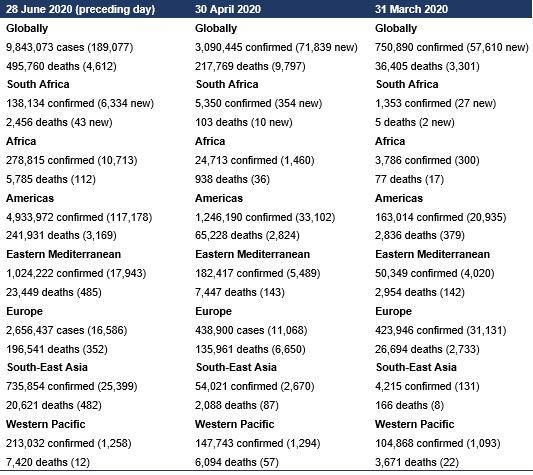
Covid-19 update
Source: WHO, NICD
Economics and markets
- The US has now experienced a new high in the daily covid-19 infection rate, with a number of emerging-market economies also seeing an acceleration.
- In positive news, China’s industrial profits rebounded in May.
- This morning’s Asian trading session shows the Nikkei, Hang Seng, ASX and Shanghai all trading in the red, with the Nikkei and ASX close to erasing June’s gains.
- In the current risk-off environment, the rand will most likely trade with a bias toward weakness.
- For many economies, June Manufacturing PMIs are set for release this week, as is SA’s 1Q20 GDP and the current account balance.
- USD/ZAR opens at 17.29; EUR/ZAR at 19.40; GBP/ZAR at 21.33 and CNY/ZAR at 2.43.
This week, we will mark the move to the second half of 2020. Not all that long ago, this was also expected to mark the acceleration in global economic activity, and the much hoped-for V-shaped recovery. It is becoming clearer that this is unlikely to be the case. While new infections remain relatively well contained in Europe and parts of Asia, there is a definite acceleration in new infections in the Americas, where the US has now experienced a new high, with a number of emerging-market economies also seeing an acceleration, South Africa not excluded. Depending on the tracker you follow, some report that global cases have already breached 10 million people, and deaths 500,000. The World Health Organisation’s figures aren’t quite there yet, but are very likely to confirm these breaches as early as today.
Thus, while some good news comes out of China in the recovery of industrial profits in May, global economic activity is at risk of stalling. It is becoming more unpalatable for lockdowns to intensify, as suggested by the acting Mayor of Nelson Mandela Bay, as lockdown, while aiming to minimise infection rates and thus avoid overwhelming the medical sector, does threaten to push rates of starvation and poverty higher, conditions which also have heightened fatalities. An unenviable trade-off to weigh up for any policymaker. However, with lockdown easing, waves of infections will keep productivity low as people have to stay away from work, either due to infection or exposure, and businesses are temporarily closed for deep cleaning, not only in SA, but globally. A few good reasons why we will probably see the continuation of a risk-off trading environment this week. This can be no clearer than when looking at the Asian trading session this morning, with the Nikkei, Hang Seng, ASX and Shanghai all trading in the red, and the Nikkei and ASX close to erasing June’s gains. It would take two very poor trading days on the JSE to erase the All-Share and JSE Top 40’s 6.3% gain for June, however, in the current environment, this is not infeasible. Similarly, the rand will most likely show bias for weakness, trading between 17.20 and 17.50 against the greenback.
Short of our accelerating infection rates, the week will be a busy one, with June Manufacturing PMIs set for release for many economies, and domestically, the release of 1Q20 GDP, the current account balance for the same quarter, as well as the private sector credit extension, trade balance and government budget figures for May being released. Any surprises, positive or otherwise, could affect markets somewhat, but it will be developments that speak to future economic activity that will be stronger market drivers, as well as drivers of continued volatility.
It will be a busy week, with plenty of news flow to move markets. Brace yourself!
Siobhan Redford
Local rates
Most of the action on Friday was centred in the afternoon when the National Treasury unexpectedly announcing an increase in bond issuance, with an extra R500m in nominal bonds and R600m in inflation bonds issued per week. This reversed some of the bond rally that we saw on Friday, but the bond curve continued to flatten, with the long end rallying 10bp from Thursday’s close.
The inflation auction on Friday was somewhat lacklustre, as auction interest in ILBs remains muted. Yields cleared slightly higher than MTM, with the bulk of the interest seen in the I2025s. With inflation at 3% and an extra R600m in bonds issued per week, we should see yields on inflation-linked bonds track higher as the market struggles to absorb the size of the auctions on a weekly basis.
With risk on the back foot overnight due to a surge in new covid-19 cases, we should see SAGBs under pressure today. We will continue to see flattening pressure on the yield curve as the National Treasury announced a decrease in average duration of the auctions. We should see the risk in the back end of the curve shift to the belly of the yield curve.
Michelle Wohlberg
loading form...