Global: Asian assets take a knock amid rising tensions between Hong Kong and China
SA: Country to move to level 3 despite concerns over covid-19 hotspots
Rand: Outperforms EM complex but lacks momentum to strengthen more meaningfully
Local rates: Disappointing ILB auction
What to watch this week
Monday
- GE GDP SA (q/q)
- GE IFO Business Climate
- JN PPI Services
Tuesday
- GE GfK Consumer Confidence
- SA Leading Indicator
- US Chicago Fed Nat Activity Index
- US Dallas Fed Manf. Activity
Wednesday
- US MBA Mortgage Applications
- US Richmond Fed Manufact. Index
- US Fed’s Bullard Discusses Economy During the Pandemic
- GE Retail Sales NSA (y/y)
Thursday
- EC Economic Confidence
- EC Consumer Confidence
- SA PPI (y/y)
- GE CPI (y/y)
- US GDP Annualized (q/q)
- US Personal Consumption
- US GDP Price Index
- US Core PCE (q/q)
- US Initial Jobless Claims
- US Continuing Claims
- US Kansas City Fed Manf. Activity
Friday
- UK Lloyds Business Barometer
- JN Tokyo CPI (y/y)
- SA Money Supply M3 (y/y)
- SA Private Sector Credit (y/y)
- EC M3 Money Supply (y/y)
- EC CPI Core (y/y)
- SA Trade Balance Rand
- SA Monthly Budget Balance
- US Advance Goods Trade Balance
- US Personal Income
- US Personal Spending
- US PCE Deflator (y/y)
- US University of Michigan Sentiment
Covid-19 update
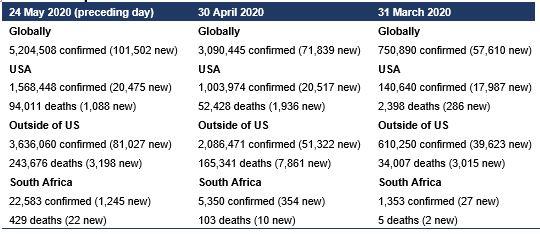
Source: WHO, NICD
Economics and markets
- Level 3 is to take effect on 1 June, and much like level 4 will still require strong levels of vigilance by South Africans.
- The mixed performance on asset pricing speaks to investor angst over whether a U-shaped recovery is forthcoming as soon as the second half of the year.
- The offshore yuan will reflect much of the market’s anxieties as investors await the US response to China’s most recent offensive against Hong Kong.
- With limited catalysts today to entrench downside momentum, EM currencies will probably consolidate at current levels.
- USD/ZAR opens at 17.64; EUR/ZAR at 19.21; GBP/ZAR at 21.43 and CNY/ZAR at 2.47.
Level 3 is to take effect on 1 June, and much like level 4 will still require strong levels of vigilance by South Africans to ensure that the peak in transmission rates is lower than the most severe epidemiological models suggest. Still, the additional freedoms afforded to industry and individuals are encouraging at a time of exceptionally depressed growth which continues to erode productive capacity. The delay in statistical data releases makes it all the more challenging to discern any improvements, which leaves us to infer progress anecdotally.
SA continues to journey through the covid-19 crisis alongside the global economy as countries progressively relieve restrictions. Yet, the mixed performance on asset pricing speaks to investor angst over whether a U-shaped recovery is forthcoming as soon as the second half of the year. Fears are exaggerated this morning by happenings in Hong Kong. China’s imposition of a new security law has provoked mass protests, reminiscent of pre-covid gatherings, as the mainland looks to quell dissenters.
The MSCI Hong Kong index continues to underperform the Hang Seng as fears manifest in Asian assets. The offshore yuan will reflect much of the market’s anxieties as investors await the US response to China’s most recent offensive against Hong Kong. As volatility ensues, the PBOC will come under increasing pressure to maintain a hold on the onshore yuan rate, which was fixed at its weakest level since 2008 on Monday. This should begin to weigh on the EM complex as we head further into the week.
EM currency movements will be exaggerated by thin trading volumes as the UK, US, Singapore, Malaysia, Indonesia and India enjoy extended weekends. This should widen the net on potential support and resistance levels for the rand, Brazilian real and Mexican peso, which are leading the EM charge. The rand and peso are among the best-performing currencies this month, though the real continues to lag its peers, amassing month-on-month losses amid concerns over the government’s response to rampant increases in covid-19 transmission rates.
With limited catalysts today to entrench downside momentum, EM currencies will probably consolidate at current levels, suggesting that the rand remains magnetised to the 17.56 level. Despite still trading above crisis levels, implied volatility on USD/ZAR continues to recede, albeit slowly, suggesting a softening in perceived risks.
Nema Ramkhelawan-Bhana
Local rates
While it has been a bit unclear what impact an increase in issuance would have on the weekly auction, Friday’s ILB auction pointed to a lack of interest and/or possibly an oversupply of stock. Going into the auction, we’d seen some activity on the back end of the linker curve, but come Friday the I2025s cleared auction at 3.80 with a bid-to-cover ratio of 1.40, the I2038 cleared auction at 4.66 with a bid-to-cover ratio of 1.90 while the I2050s cleared auction at 4.68 with a bid-to-cover ratio of 2.30.
The mark-to-market was 3.77, 4.65 and 4.66 respectively on the day; flows were subdued, but we saw buyers of R197s, I2029s and I2046s. The nominal bond market is still not seeing much trading activity from local investors, with generally two-way flows across the curve albeit in smaller tranches. The sub 10-yr tenor on the swap curve had tiny receiving interest from local real money, there is still no liquidity in the interest rate derivatives market but there were cares in longer-dated packs towards the end of the week. The rand is trading just a few cents above 17.50 this morning – good luck out there.
Tebogo Mekgwe
loading form...