
GM Daily: A pinch and a punch, it’s the first of the month
Global: Slow but steady progress towards US stimulus
SA: Fourth month of trade surpluses
Rand: Mind-boggling strength
Local markets: Uncertainty to rule market flows
What to watch today
- JN Jibun Bank Japan PMI Mfg
- GE Markit/BME Germany Manufacturing PMI
- EC Markit Eurozone Manufacturing PMI
- UK Markit UK PMI Manufacturing SA
- SA Absa Manufacturing PMI
- EC PPI (y/y)
- EC Unemployment Rate
- SA Electricity Production (y/y)
- SA Electricity Consumption (y/y)
- US Initial Jobless Claims
- US Markit US Manufacturing PMI
- SA Naamsa Vehicle Sales (y/y)
Covid-19 update
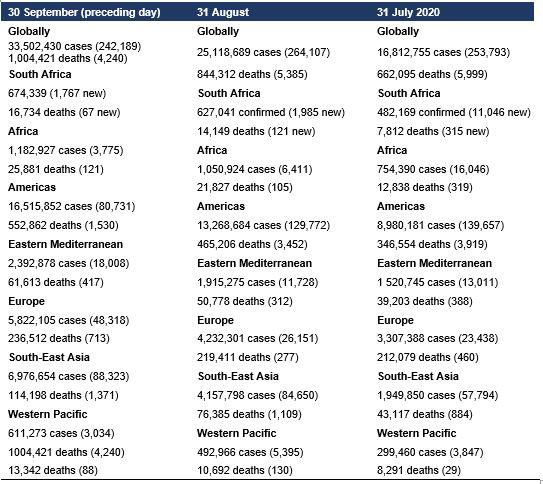
Source: WHO, NICD
Economics and markets
- Signs of economic recovery are broadening, but repeated waves of covid-19, eight months after the initial outbreak, continue to demand sustained policy support.
- US job losses are becoming more pronounced in sectors reliant on emergency aid, even though private employers are creating employment opportunities.
- Markets are holding out for additional stimulus, clutching at any and all positivity.
- Moves will be exaggerated amid light trade as much of Asia celebrates the mid-Autumn Festival.
- The rand’s seesaw effect and outperformance versus its EM peers is mind boggling.
- USD/ZAR opens at 16.74; EUR/ZAR at 19.62; GBP/ZAR at 21.65 and CNY/ZAR at 2.46
A pinch and a punch, it’s the first of the month. A childish sentiment but a firm reality check as we begin the fourth quarter of 2020. Signs of economic recovery are broadening, but repeated waves of covid-19, eight months after the initial outbreak, continue to demand sustained policy support, elevating the importance of personalities like Nancy Pelosi and Steve Mnuchin. The speaker of the House and US Treasury Secretary are making progress on a stimulus proposal, albeit at a snail’s pace.
Despite the support offered by the Fed, the US economy requires a fiscal boost to counter the long-term effects of the pandemic. Job losses are becoming more pronounced in sectors reliant on emergency aid, even though private employers are creating employment opportunities, having generated a better-than-expected 749,000 roles last month. Overall jobless claims remain stubbornly high, as is the case globally. We need only look to South Africa’s own dire unemployment statistics.
Friday’s US employment report will provide a holistic view of its labour market – a moot point at Tuesday’s presidential sparring match. For as long as the economy is left wanting of fiscal stimulus, the Fed will need to do the heavy lifting. The extension of constraints on dividend payouts and share buybacks for the US’s largest banks through to the end of the year is merely an example of the measures that need to be maintained due to continued economic uncertainty.
Markets are holding out for additional stimulus, clutching at any and all positivity. European stocks have risen for the first time this week following an advance in Asian and US futures. The slew of PMI data from across Eastern and Western Europe might provide some cheer if signs of continued recovery are evident. Moves will be exaggerated amid light trade as much of Asia celebrates the mid-Autumn Festival. The market closures are amplified by the outage on Tokyo’s bourse with no discernible timeframes as to when trading will resume. The improvement in Japan’s Tankan survey of manufacturers has almost gone unnoticed as a result.
That doesn’t seem to have distracted from the general liveliness boosting risk assets. The rand’s seesaw effect and outperformance versus its EM peers is mind boggling. SA’s August trade surplus (reported yesterday) is hardly enough to have triggered such as sharp rally. Having breached the all-important 200-day moving average of USD/ZAR16.70, the market is looking to further rand gains. Sellers will probably target the pair’s resistance level at 16.85, though it’s unlikely the unit will gap sharply higher amid US dollar weakness. Given the erratic nature of the spot rand, we defer to the options market to discern market sentiment. While the two-month implied volatility on USD/ZAR is still elevated, it has subsided following Tuesday’s farcical US presidential debate.
Front-end risk reversals have ticked up a bit but aren’t at levels that would imply the market anticipates a blowout. That said, there’s a general bid tone despite the recent rand strength, reflecting uncertainty over upcoming local and global event risk. Politicking will drive angst, but if the market becomes more comfortable with Biden winning by a wide margin, risk premiums might reduce, which is positive for EM assets.
Nema Ramkhelawan-Bhana
Local rates
With the number of events due in the next two months, it's no wonder that markets are volatile and illiquid and it feels like a lot of investors have de-risked ahead of the US elections and MTBPS. SAGBs have not been spared, with daily turnover in bonds falling by almost half from what we saw a month ago. Bonds had a good day yesterday, tracking the currency lower. The dovish CPI print helped anchor the front end lower, but the auction announcement weighed on the back end of the curve as the National Treasury announced R2030s, R2040s and R2048s on offer.
Bonds should continue tracking the currency for direction today as it dictates general risk sentiment. With US elections, Brexit, MTBPS and rating agency reviews all in the next two months, bonds will continue to trade in a narrow range with liquidity remaining thin. On the data front, we have local PMI, electricity consumption and production figures as well as vehicle sales released.
Michelle Wohlberg
loading form...